

Israeli Police Prevent Latin Patriarch, Custos From Entering Church of the Holy Sepulcher on Palm Sunday
By: OSV News
For the first time in centuries, Church leaders were barred from celebrating Palm Sunday Mass at one of Christianity’s holiest sites
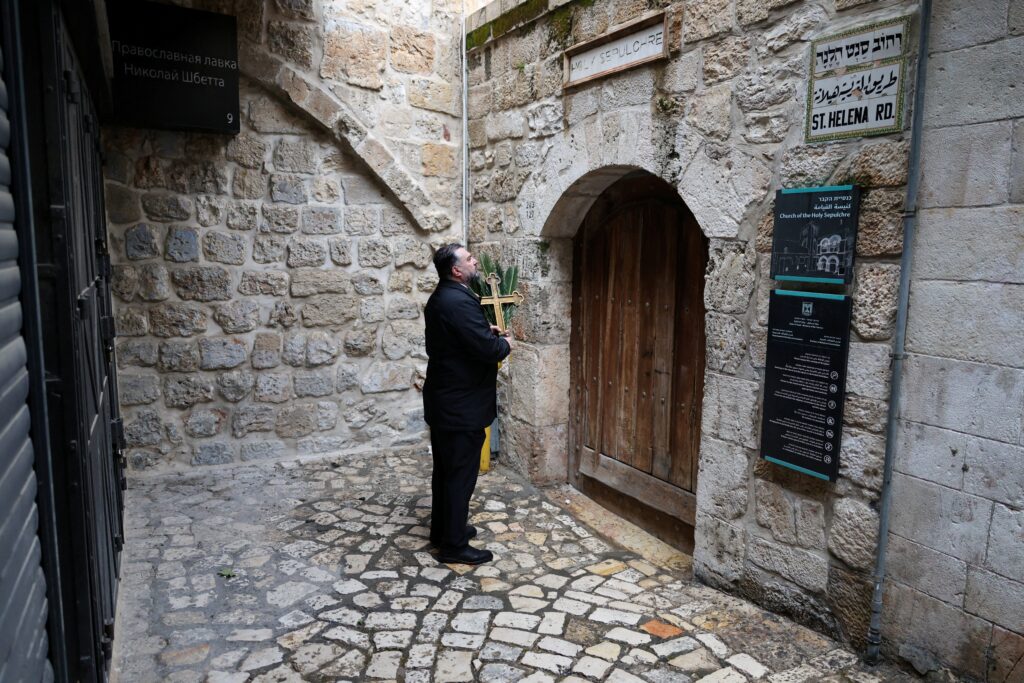
(OSV News) — Cardinal Pierbattista Pizzaballa, the Latin patriarch of Jerusalem, and Franciscan Father Francesco Ielpo, the custos of the Holy Land, were prevented from entering the Church of the Holy Sepulcher by Israeli police on Palm Sunday, the Latin patriarchate said.
In a statement published March 29, the Latin Patriarchate of Jerusalem said that although abiding by restrictions due to the Israeli-U.S.-led war in Iran, “the two were stopped en route, while proceeding privately and without any characteristics of a procession or ceremonial act, and were compelled to turn back.”
“As a result, and for the first time in centuries, the Heads of the Church were prevented from celebrating the Palm Sunday Mass” at the Church of the Holy Sepulcher, the patriarchate said.
“This incident is a grave precedent, and disregards the sensibilities of billions of people around the world who, during this week, look to Jerusalem,” it said.
Holy sites closed since February
The Church of the Holy Sepulcher was among several holy sites in the Old City of Jerusalem, including the Western Wall and the Temple Mount, that were closed since February 28, after Israel and the U.S. launched their joint attack against Iran.
The Custody of the Holy Land said in a statement on March 21 that it was in dialogue with authorities and was awaiting “clear indications” regarding Holy Week celebrations.
Italy’s Prime Minister Giorgia Meloni expressed her solidarity with Cardinal Pizzaballa and Father Ielpo, the Italian newspaper La Repubblica reported.
Noting that the Church of the Holy Sepulcher is “a sacred place of Christianity,” the prime minister said the church “must be preserved and protected for the celebration of sacred rites.”
“Preventing the patriarch of Jerusalem and the custos of the Holy Land from entering, especially on a solemnity central to the faith such as Palm Sunday, constitutes an offense not only to believers, but to every community that recognizes religious freedom,” she said.
Italy summons Israeli ambassador
In a post on the X social media platform on March 29, Antonio Tajani, Italy’s foreign minister, announced that he summoned Jonathan Peled, Israel’s ambassador to Italy, “to receive clarifications on the decision to prevent Cardinal Pizzaballa from celebrating Palm Sunday.”
In a separate post, Tajani said the actions by Israeli authorities to prevent Church leaders from celebrating Palm Sunday were “unacceptable.”
“I have given immediate instructions to our ambassador in Israel to convey to the authorities in Tel Aviv our government’s protest and to confirm Italy’s position in defense, always and in every circumstance, of freedom of religion,” he wrote.
The Israeli authorities’ action took place as Houthi militants in Yemen became the latest combatants to enter the Iran war by firing missiles at Israel on March 28 in support of their Iranian backers and threatening Red Sea shipping.
Since the U.S. and Israel launched a massive surprise attack on Iran on February 28, amid ongoing negotiations over Iran’s nuclear program, the war has engulfed more and more countries in the Middle East, sending shockwaves through the global economy.
A “flagrant crime” against journalists
In Lebanon, Israel launched an airstrike on March 28 that killed three journalists, claiming one of them was involved in providing intelligence to Hezbollah, the Shia Lebanese militia group that joined the war on the side of Iran on March 2. Lebanon’s President Joseph Aoun, a Maronite Catholic, denounced the targeted killing as a “flagrant crime” against international laws protecting journalists.
The same day, Israel’s military said Hezbollah, which is officially banned from fighting by Lebanon’s government, fired 250 missiles against Israel within the past 24 hours.
Israel’s ground invasion and air strikes have displaced a million Lebanese from their homes in the country’s south, killing 1,000 people and raising fears that one of the last major enclaves for Christians in the Middle East will face the kind of destruction Israel inflicted on the Gaza Strip in its war against Hamas.
In the joint statement on March 29, the Custody of the Holy Land and the Latin Patriarchate of Jerusalem said that since the start of the Iran war, it had complied “with all imposed restrictions,” including canceling public gatherings and arranging for Holy Week celebrations to be broadcast.
“Manifestly unreasonable and grossly disproportionate”
However, the Israeli authorities’ actions in preventing the entrance of Cardinal Pizzaballa and Father Ielpo, “who bear the highest ecclesiastical responsibility for the Catholic Church and the Holy Places, constitute a manifestly unreasonable and grossly disproportionate measure,” the statement read.
“This hasty and fundamentally flawed decision, tainted by improper considerations, represents an extreme departure from basic principles of reasonableness, freedom of worship, and respect for the status quo,” it said.
The Latin patriarchate and the custody expressed their “profound sorrow” to Christians around the world, noting that prayers “on one of the most sacred days of the Christian calendar have thus been prevented.”
Pope Leo echoes sentiments of sorrow
Pope Leo XIV echoed those sentiments before praying the Angelus prayer with the faithful gathered in St. Peter’s Square to celebrate Palm Sunday.
The pope offered prayers for the Christians of the Middle East “who are suffering the consequences of a brutal conflict and, in many cases, are unable to observe fully the liturgies of these holy days.”
“Just as the Church contemplates the mystery of the Lord’s Passion, we cannot forget those who today are truly sharing in his suffering. Their ordeal challenges all our consciences,” the pope said.
“Let us raise our prayer to the Prince of Peace that he may sustain the peoples wounded by war and open concrete paths to reconciliation and peace,” he said.
– – –
Junno Arocho Esteves is an international correspondent for OSV News. Follow him on X.