

America250: St. Isaac Jogues and St. Kateri Tekakwitha
By: The Good Newsroom
The Catholic roots of New York reach back more than a century before the founding of the United States
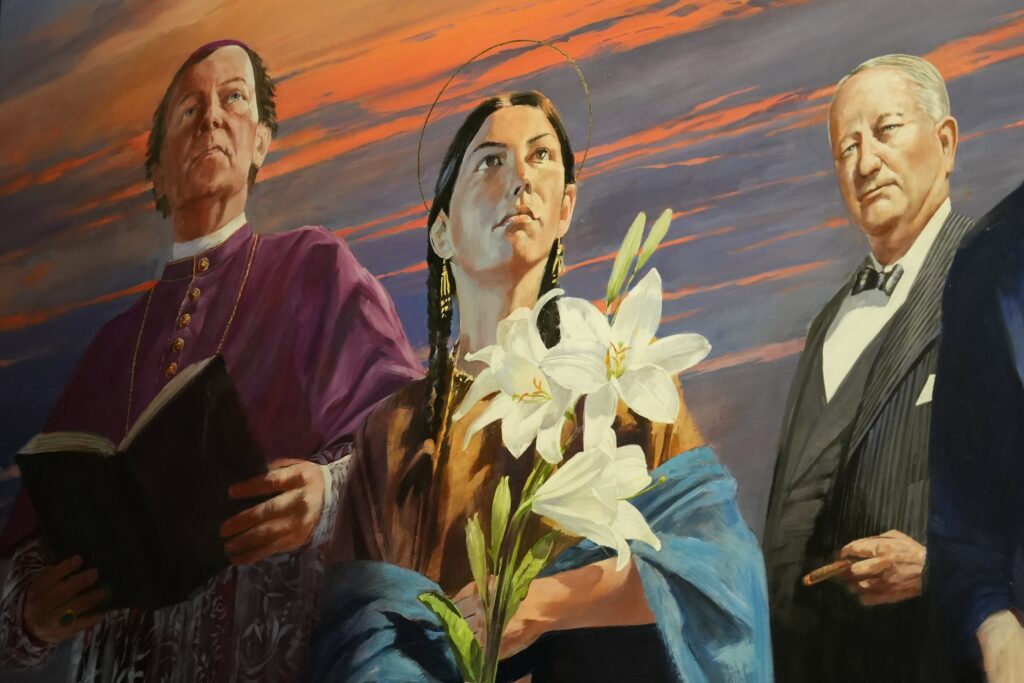
As the United States prepares to celebrate its 250th anniversary on July 4, The Good Newsroom presents a series on the Catholic history of New York.
Long before New York had an archbishop, a cathedral, or a Catholic school, it had martyrs. The Catholic story in this state does not begin in lower Manhattan or on the steps of St. Patrick’s. It begins in the Mohawk Valley, in the 17th century, on ground that would not become part of the United States for another hundred years.
A missionary arrives
Fr. Isaac Jogues left France in 1636 as a young Jesuit priest, with no illusions about what the mission to New France might cost him. Born in Orléans in 1607, he spent his first years in North America among the Huron people of the Great Lakes region, learning their languages and traveling routes that no European cartographer had yet recorded. He was the first European to reach Lake George, which he named Lac du Saint Sacrement, the Lake of the Blessed Sacrament, a name that said everything about his view of the land he was crossing.
In 1642, a Mohawk war party captured Fr. Isaac Jogues and a group of Huron Christians he was escorting back from Quebec. His companion René Goupil, a lay missionary brother, died within weeks, killed for making the sign of the cross over a child. Fr. Isaac Jogues survived more than a year of captivity, suffering torture and forced labor, before Dutch traders at Fort Orange, the settlement that would become Albany, ransomed him and put him on a ship back to Europe.
A departure and a return
He returned to North America within the year and, by 1646, was back at Ossernenon. In this Mohawk village, he had been held captive and was now working to build peace between the Mohawk nation and the French colonial authorities to the north. Adopted into the Wolf Clan, he had people who depended on him and a small Christian community taking root around him.
It was not enough to save him. Factional conflicts within the village boiled over, and members of the Bear Clan used the pretext of a recovered Mass kit to draw Fr. Isaac Jogues into a longhouse and kill him. He was 39. Pope Pius XI canonized him in 1930, along with five fellow Jesuits martyred in Canada, as the first saints of North America. The group is often referred to as the North American Martyrs or the Canadian Martyrs. The shrine that bears their memory, the National Shrine of Our Lady of Martyrs, stands today in Auriesville, on the ground where he died.
WATCH: Saints of New York: St. Isaac Jogues and the North American Martyrs
Born on the same ground
Ten years after St. Isaac was killed at Ossernenon, a girl was born there to a Mohawk chief and a Christian Algonquin mother who had encountered the faith through earlier missionary work. The girl never knew either of them. A smallpox epidemic devastated Ossernenon when she was four years old, killing her parents and her younger brother and leaving her with permanent damage to her eyesight and scarring on her face. Her new name, Tekakwitha, meant roughly “she who bumps into things,” and she would keep it the rest of her short life.
What the epidemic could not touch was whatever was growing quietly inside her. When Jesuit missionaries began visiting her village, she listened to them with an attention that other members of her family disliked and discouraged. The faith her mother had held, and that the martyrs had died for, was finding its way to her.
A life of radical devotion
At 20, Kateri Tekakwitha was baptized, over the determined objections of the uncle who had raised her, and the consequences were immediate. She was mocked, threatened, and made to feel unwelcome in the community where she had grown up. She refused to work on Sundays and would not consider marriage, positions that marked her as an outcast; in the winter, she rose before dawn to kneel outside the locked chapel, waiting for it to open.
Eventually, she left, making the long journey to Kahnawake, a Catholic Mohawk settlement near Montreal, where she could live her faith without harassment. She died there in 1680, during Holy Week, at the age of 24, her last words the names of Jesus and Mary. Stories of miraculous healings attributed to her intercession began circulating almost immediately after her death. Kateri Tekakwitha was beatified by then-Pope John Paul II in 1980, then canonized by Pope Benedict XVI on October 21, 2012, making her the Church’s first Native American saint.
WATCH: Saints of New York: The Witness of Saint Kateri Tekakwitha
A story older than the nation
As the United States marks its 250th anniversary, it is worth pausing to consider what St. Isaac and St. Kateri together represent. The Catholic presence in New York did not arrive with the immigrants, although it was deepened immeasurably by them. It did not begin with the Diocese of New York, which, later as an archdiocese, has carried it forward for more than two centuries. It began here, in the valley of the Mohawk River, with a priest who came back when he didn’t have to and a young woman who held on when almost everything argued against it.
Pilgrims still go to Auriesville. They walk the same hills. The ground there has been holding this story for nearly 400 years.