



America250: St. Elizabeth Ann Seton and Archbishop John Hughes
By: The Good Newsroom
Two builders shaped the early period of Catholic New York
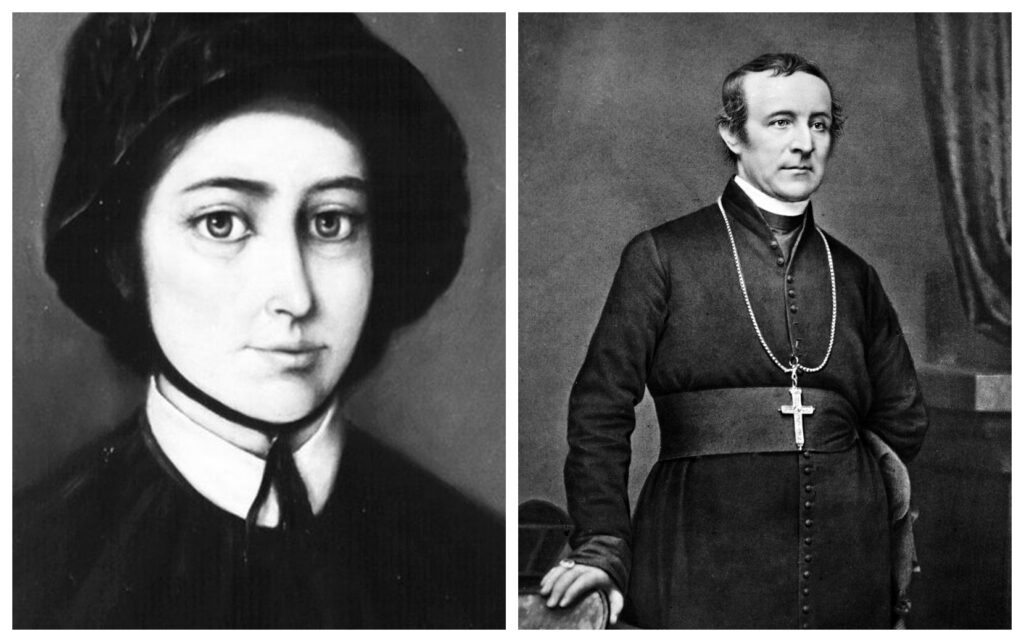
The Catholic Church that New Yorkers now know, with its parish schools, medical facilities, and iconic cathedral in Manhattan, did not arrive fully formed. It was assembled, piece by piece, by builders and architects of the Church, both literal and figurative. St. Elizabeth Ann Seton and Archbishop John Hughes did not work together directly, but one built upon the other’s foundation to create much of the Archdiocese of New York’s infrastructure today.
The first native-born saint
Elizabeth Ann Bayley Seton’s contribution was personal before it was institutional. Born in 1774 to a wealthy Anglican family with roots among the French Huguenot founders of New Rochelle, she grew up seeing her city occupied by British troops during the American Revolution, an early education in the price of conviction.
She married into shipping wealth, had five children, and helped found New York’s first private charity in 1797 with a circle of women that included Alexander Hamilton’s wife. By any measure of her era, Elizabeth Seton’s life was comfortable and stable.
Then it came apart. A trade war with France ruined the family’s shipping business, her husband’s health collapsed, and the two of them sailed for Italy chasing a cure that never came. He died within weeks of landing.
While staying with her husband’s Italian business partners following his death, Elizabeth was struck by a depth of Catholic devotion she hadn’t expected. She brought that faith home, and when she and her daughter returned to New York a year later, she resolved to convert. In March 1805, she converted to Catholicism at the Church of St. Peter on Barclay Street, then the city’s only Catholic parish. For three years she raised five children alone in New York before accepting an offer to open a girls’ school in Baltimore, at the time the seat of American Catholicism, where she founded the country’s first native religious order, the Sisters of Charity.
What she built there became the template for Catholic education across the country. When she died, aged only 46, parochial schooling and an American sisterhood devoted to it existed because she had willed and worked them into existence, an achievement contemporaries recognized: Archbishop Francis Kenrick of Baltimore later told his fellow bishops she had done more for the American Church than all of them combined.
Pope Paul VI, during her canonization in 1975, called St. Elizabeth Ann Seton “fully American.” Her name still resonates throughout the area: the St. Elizabeth Ann Seton Shrine at her former State Street residence near the southern tip of Manhattan, Seton Falls Park, Bayley Seton Hospital, Elizabeth Seton Children’s in Westchester, and a parish in Shrub Oak, along with Seton Hall University in nearby New Jersey. Cardinal Timothy Dolan, marking her legacy in 2024, called her “the first American saint, known here in New York for caring especially for children in need.” She gave the New York Church an idea of itself before it had the buildings to match.
The man who built the buildings
Unlike St. Elizabeth Ann Seton, John Hughes was not born in the United States, either before or after the American Revolution. Born on June 24, 1797, in Annaloughan, County Tyrone, Ireland, he emigrated to the United States in 1817 seeking opportunities he could not find in his native country.
Wanting to enter the seminary, Hughes applied at Mount St. Mary’s Seminary in Emmitsburg, Md., but was initially turned down as a student, staying on instead as a gardener. Some accounts credit Mother Elizabeth Ann Seton, then living nearby, with helping the young Irishman get a second look. Hughes was ordained a priest of the Diocese of Philadelphia on Oct. 15, 1826, by Bishop Henry Conwell.
Father John Hughes was consecrated as a bishop on January 7, 1838, joining Bishop John Dubois as coadjutor of the Diocese of New York. Dubois’ health was already failing, and within a year, as it continued to decline, Bishop Hughes was appointed apostolic administrator of the diocese.
Upon Bishop Dubois’ death in 1842, Bishop Hughes succeeded him as the fourth bishop of New York, administering a diocese that covered 55,000 square miles of New York State and northern New Jersey with just 38 churches and 50 priests for 200,000 Catholics, most of them poor, many of them Irish famine refugees he later described as arriving in a state of destitution that was “almost inconceivable.”
One of his earliest tasks was bringing order to parish finances. Bishop Hughes worked to restore the authority of the bishop’s office, arguing that the parish trustees answered to the diocese, not the other way around.
That authority soon went toward education. New York’s public schools were funded by the state but run by a private society, and Catholic families found that the curriculum left little room for their children’s faith. Archbishop Hughes petitioned the state for a share of public education funds so Catholic children could be taught in keeping with their own beliefs.
The petition did not succeed as written. The Legislature abolished the school society in 1842 but barred religious instruction from public classrooms altogether, leaving Catholic families without the accommodation Bishop Hughes had sought. He responded not with further appeals but with construction, resolving that the diocese would build and staff its own schools rather than wait on the state. “The schoolhouse,” he said, would come “first and the church afterward,” and from that commitment grew the Catholic school network the archdiocese still operates today.
This was followed by two decades of sustained construction, literal and institutional. When Pope Pius IX elevated New York to an archdiocese on July 19, 1850, he appointed Archbishop Hughes its first archbishop. He went on to lay the cornerstone of the present St. Patrick’s Cathedral in 1858, construction that at the time was seen as folly. Time has proved Archbishop Hughes right, with “America’s Parish Church” standing as one of Manhattan’s best-known landmarks.
Msgr. Thomas J. Shelley, the late archdiocesan historian, captured the scale of his influence: “In New York, no one had to ask who ruled the Church. John Hughes was boss…. He ruled like an Irish chieftain.”
Legacy
St. Elizabeth Ann Seton gave the New York Church its conscience and its classroom model. Archbishop Hughes gave it the institutional scale to implement both across the archdiocese. A convert’s school turned into a national movement, and an immigrant archbishop’s vision turned into an archdiocese, shaping the way Catholic New York looks today.
— Fernanda Pierorazio and Catholic New York contributed to this article.