



Don't Lose Hope, Jesus Is in the Boat With Us, Archbishop Hicks Says
By: Vatican News
In Rome, Archbishop Ronald Hicks discusses his vocation, prayer life, and the Church’s mission in a city hungry for hope
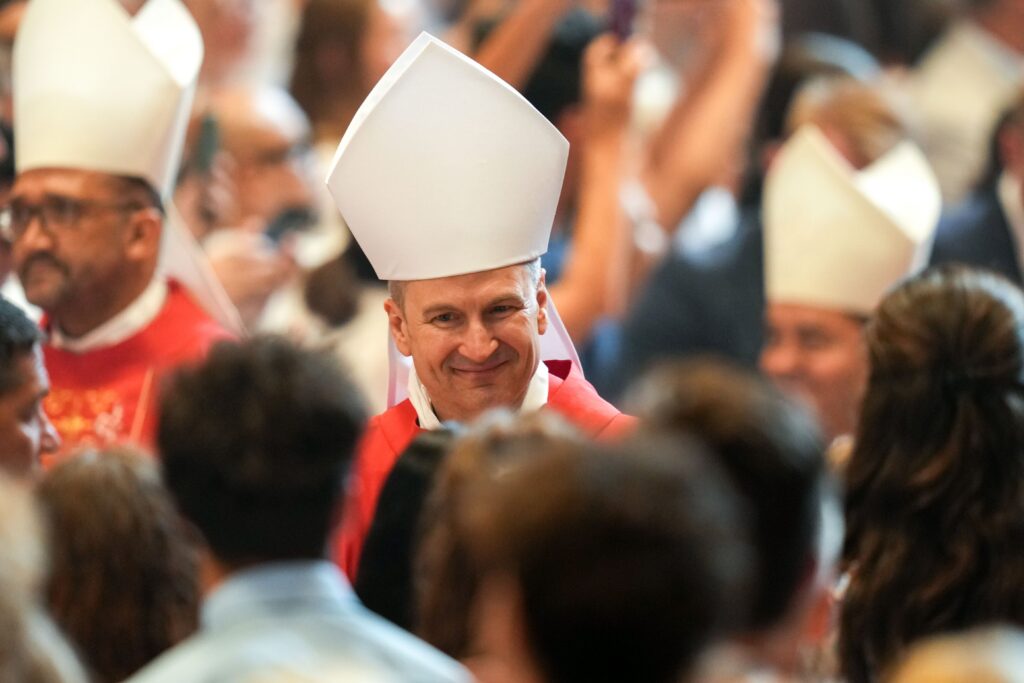
Sitting down with Vatican News in Rome after receiving his pallium from Pope Leo, Archbishop Ronald Hicks discussed what has surprised him most about New York and New Yorkers, and what they have taught him about the faith. He also addressed what he perceives to be the greatest challenges and opportunities for his archdiocese in such a one-of-a-kind city, and shared some personal details, including how he discovered his vocation, his prayer life, and how the Church and its powerful message can effectively counter a secular society and world.
Observing an increase in young adults re-engaging in the faith suggests they are seeking true meaning in life amid “the brokenness of the world, of what a world looks like when it is not connected to faith, a moral tradition, or some values to ground and lead them.”
“I want to ensure that we intentionally help, not only young people, but people of all ages, to come to know, love, and serve the Lord. At the same time, we must continue to be a Church that is not self-referential, but a Church that is on mission and in service to others. That’s the type of shepherd that I am striving to be,” he said.
Vatican News: Archbishop Hicks, you received the pallium from Pope Leo in St. Peter’s Basilica on Monday. What did that moment mean to you personally, and how does it shape the mission you see before you as Archbishop of New York?
It was a significant moment, especially to be united with the Holy Father. With that pallium placed over my head, and placed over the heads of my brother Metropolitan Archbishops, we are saying we are in unity with, united with, our Holy Father. He gave a beautiful homily about the necessity of unity and, on the Solemnity of Saints Peter and Paul, how these two Saints were so different, so diverse, and yet unified with their love for the Lord and in wanting to share His mission. The Holy Father encouraged us to take the example of those two extraordinary leaders in our Church and be united with him as he leads and shepherds the Church.
You also received the pallium from the first American, first United States-born Pope, also from a nearby Chicago suburb. What emotions did that evoke for you?
Our houses were 14 blocks away; you could ride your bike back and forth to each other.
I had a lot of emotions, especially gratitude and awe. It was a holy, sacred, beautiful Mass in which we gathered in St. Peter’s around the Eucharist, and the whole world was there. I felt very grateful to be part of this Church, to be called to follow our Lord in a specific way, and also grateful to all the people who were accompanying me, not only physically at the Mass, but also all those who have promised their prayers. It gave me great joy. It was like having a piece of heaven. I’m grateful for every moment.
Since arriving in New York, what has surprised you most, both about the city and about the people? And what have New Yorkers taught you about the faith?
What surprised me most has been the gracious welcome. So I bought into the stereotype that many New Yorkers would be rough, rude, and fast-paced, and, instead, I have received this gracious welcome, not only from Catholics but from New Yorkers all over. I can go in and buy a slice of pizza, and the person behind the counter will recognize me and say, “Are you the new one?” I said, “Yes, I’m the new one.” He said, “Well, welcome to New York. Congratulations. We’re happy that you’re here.”
It’s been that type of welcome that I have received, and I’ve done nothing really to earn that welcome, but it’s been gracious and given freely, and I’m very grateful for it.
What have I learned? What I’ve learned from that is: one, don’t stereotype people until you experience them for yourself; two, that New York is a microcosm of the world. It’s like we say in the Church, “Here comes everybody.” That is true for the Archdiocese of New York; everyone has a different story. What I love so far is how much they love New York, how much they love the Archdiocese, how much they love the Church, how much they love Jesus, and together want to do something good, perhaps even for the common good.
Every Archbishop encounters challenges unique to his local Church. New York, in many ways, is a city like no other. What have been and what are some of the greatest challenges? And what do you see as being some of the greatest opportunities?
Like any Diocese in the world, we have a lot of challenges, and I am not going to go into all the challenges that we have currently, that we, in a very intentional way, are addressing. However, as I look at all of those challenges that have been given to me and that exist, I also see the opportunities. I see New York, like so many places across the country and the world, that there is a re-engagement in the faith, especially among young adults.
Because New York is a center of so many young adults, we’re seeing that in real ways. Young people in their 20s and 30s are going back to Church, looking for community, wanting to serve, and don’t know how to do it. They want to make the world a better place, and they can turn to the Church, which knows how to put faith into action, and to serve and to volunteer. It gives them a structure for it. I look at all those real opportunities. While we are engaged in this, I also want to make sure we are concentrating on formation, education, catechesis, and also evangelization. I want to ensure that we take this moment and help intentionally, not only young people, but people of all ages, to come to know, love, and serve the Lord. At the same time, we must continue to be a Church that is not self-referential, but a Church that is on mission and in service to others. That’s the type of shepherd that I am striving to be. As I listened to Pope Leo address us, I saw that’s the type of shepherd he is calling us to be. I feel that my heart is very much united with his heart.
If I may ask you a more personal question, how did you discover your vocation?
There is some data out there that most priests can describe one person who asked them to consider either studying for the priesthood or entering the seminary. Like so many, I can identify that one person. When I was in sixth grade, there was a priest who was newly ordained that we thought was just … Well, he was a hero to all of us. And this “hero” of mine said, “I think you’d be a great priest, and I think you should consider going to the high school seminary.” That wasn’t on my radar. That is not what I was thinking of doing when I was in sixth grade, but because he saw something in me and asked, all of a sudden, the seed was planted. From that experience, I entered the seminary at age 14 and continued to be in the seminary system and be formed, also with missionary work throughout the seminary and throughout my priesthood. It is thanks to someone who asked, someone who supported, people who prayed for me and built a system that educated and formed me, and ultimately launched me out on mission as a priest. For all the steps along the way, I realize that it does not happen by chance. You actually have to make it, grow it, and own it. For everyone who has made that whole journey possible for me and for so many others who have gone on to the priesthood, I am nothing but grateful.
Turning a little to your own spirituality, are there certain prayers or devotions, or something in particular, that you turn to?
I love the Eucharist, and I love the celebration of Mass. As a diocesan priest, that Eucharist, that celebration of the Holy Sacrifice, is at the center of my prayer. But at the same time, I also need to have a way of uniting my heart with the heart of Jesus so that I can do the will of the Father. I want to follow the example of our mother, Mary, who showed how to do the Father’s will perfectly in her life, from the very beginning, with all of her yeses along the way. To do that, I need to be grounded in prayer. As a Bishop, I make sure there’s not a single day that goes by that I have not spent time in prayer. It just cannot be just a couple of minutes, where you say a couple of Hail Marys and then a couple of Our Fathers and you’re done. It is taking some time in quiet through the Liturgy of the Hours. It’s through that. It’s also spending some quality time in front of the Blessed Sacrament in Eucharistic adoration, and making sure that in those quiet moments, again, I am listening to the Holy Spirit, opening my heart, uniting it with Jesus, and really asking to do the Father’s will.
Society often sends conflicting messages. Pope Leo, following his predecessors, and in particular, Pope Benedict XVI, has spoken about the challenge of relativism… How can the Church engage with an increasingly secular culture and help people find meaning through the Truth, particularly in a city like New York?
I think sometimes we have a false humility, and because of the false humility, we refuse to share any of our faith outside of our own private prayer life or what we do in Mass, that our faith then gets put on a shelf, and then we go live with our families and in our neighborhoods and go to work, and they’re not connected at all. I think we have to get beyond that. I think our faith has to be integrated. None of us wants to proselytize or beat other people up with a bat with our faith over their head, but we’re called to be evangelizers and to help introduce Jesus Christ and salvation through Him to others. Therefore, we have to look for opportunities for prayer, even outside of Church with other groups. We must start, or continue to find opportunities for this.
I believe that the reason why we are seeing an increase in young adults re-engaging in the faith is they’ve seen some of the brokenness of the world, of what a world looks like when it is not connected to faith or to a moral tradition, or to some values or virtues that ground you and lead you, of a world that says “Just do whatever you want, think whatever you want. Your happiness is your happiness, mine is mine.” There has to be something more. Young people are looking for that right now, and they’re finding that in the Church.
Many Americans feel anxious or uncertain about the future. As a pastor, what message of hope would you like to share with them?
Never lose hope. Jesus is always in the boat with us. In today’s Gospel, we were reminded that there are storms, the torments, the waves, and Jesus is asleep… And it doesn’t mean that Jesus doesn’t care. It means that Jesus is at perfect peace, that He shares that peace with all of us, all of us who follow Him.
Thus, my message is that in all of the problems and the torments, and in all of the suffering and issues and challenges that we have, never lose sight of that hopeful message that Jesus is in the boat with us. He’ll never abandon us, and He leads us on mission. All He does is invite us to follow Him and to live that faith.