


Pope Leo Invites Americans to Cultivate 'Moral Greatness' as He Accepts Liberty Medal
By: OSV News
Pope becomes the second religious leader to receive the honor from the National Constitution Center
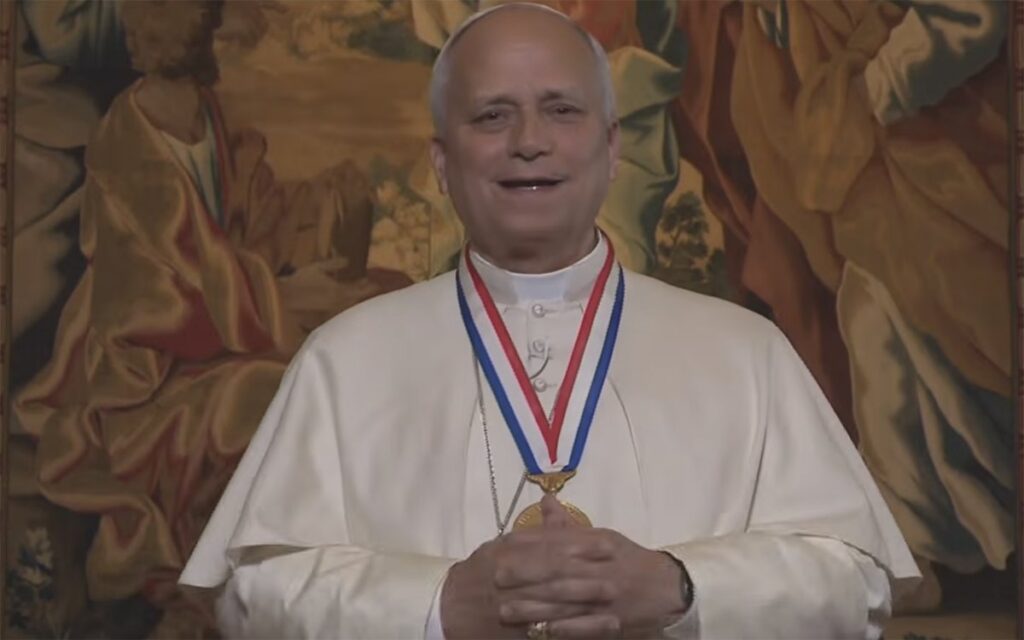
PHILADELPHIA (OSV News) — Religious liberty “holds sacred the inner sphere of the person where convictions are formed and where conscience can guide the decisions made in the intimacy of the human heart,” said Pope Leo XIV, as he accepted a major civic award for upholding freedom of belief on the eve of the nation’s 250th anniversary.
The first U.S.-born pope shared his thoughts, which centered religious liberty within a vision of God-given human dignity and called the nation back to shared founding ideals, during a July 3 acceptance address for the Liberty Medal, bestowed by the National Constitution Center in Philadelphia.
Established in 1988 to mark the bicentennial of the U.S. Constitution, and hosted by the center since 2006, the Liberty Medal honors both individuals and organizations “who strive to secure the blessings of liberty to people around the globe.”
A historic honor
The July 3 ceremony took place at the center, a private nonprofit that promotes constitutional education and civic debate, with Pope Leo speaking via livestream from the Vatican. He received a standing ovation from attendees, among them numerous faith and civic leaders.
The medal itself had been presented to the pope in person at the Vatican on April 30 by Vince Stango, the center’s interim president and CEO, center officials, and Archbishop Nelson J. Pérez of Philadelphia, who spoke at the Philadelphia event. Video of the April presentation aired at the July 3 ceremony immediately ahead of the pope’s live remarks.
Pope Leo is only the second religious leader to receive the Liberty Medal, preceded by the Dalai Lama of Tibet, the 2015 recipient.
“This honor is a fitting recognition of the Holy Father’s longstanding dedication to advancing liberty for all people throughout the world, particularly the gift of religious freedom,” Archbishop Pérez said during the event at the center.
Speaking to those at the ceremony, Pope Leo wore both the medal and his pectoral cross, with an exhibit version of the medal, blessed by the pope in April during the in-person presentation, displayed on the stage ahead of its installation in one of the center’s galleries.
Founding ideals and human dignity
Describing himself as “a son of this great country,” Pope Leo asked in his July 3 address that he join those present in asking “God’s blessings upon America’s future, that the lofty ideals enshrined at the beginning of the Declaration of Independence may continue to guide the flourishing of the nation in unity, justice, and peace.”
“From our youth, most of us have admired the eloquence of those words, their resounding appeal to the law of nature and to nature’s God as the basis of their assertion that all men and women are created equal and endowed by their Creator with certain inalienable rights, including the right to life, liberty, and the pursuit of happiness,” the pope said.
Noting that while that phrasing was “couched in the language of the Enlightenment,” the claim “is ultimately grounded in an understanding of the human person inspired by the great biblical vision of man and woman being created in the divine image,” Pope Leo said.
Such God-given human dignity, he said, “precedes the establishment of any state, and whose custody constitutes its very purpose.”
“As every American knows, however, the path to building a society that would embody those high ideals of liberty and justice for all was not always easy and, in many respects, is still a work in progress,” he said. “Indeed, the effort to realize this vision is one that must be taken up anew in each generation and in the face of ever-new challenges.”
The nation’s 250th anniversary, he continued, offers “the opportunity to reflect once again on the nation’s founding principles in the hope that America will remain ever true to the dream that has earned it the title of ‘land of the free and home of the brave.'”
The right to life and true liberty
The pope enumerated the rights “enshrined by the nation’s founders,” noting that the first was “the right to life” itself.
“A country’s vitality is deeply tied to the value it affords to human life in every form and condition, acknowledging the dignity endowed upon every human person by virtue of their very existence,” he said.
He stressed that “we must continue to cultivate such reverence” for life “from the moment of conception to natural death.”
Pope Leo noted that “the moral greatness of a nation is manifested, above all, in its capacity to support, protect, and cherish the lives of all, especially the most vulnerable and those whose worth is questioned.”
Along with the right to life, the pope said, “liberty was and is preeminent among the principles revered by the men and women who have sought within this nation’s borders a new beginning, often equating it with previously undreamed-of hope.”
He clarified that “authentic freedom runs much deeper” than “the ability to act as one would like.”
Rather, Pope Leo said, true liberty “is founded upon the human person’s capacity to know the truth and adhere to what is good, even at great cost — a sacrifice well known to many who have labored to shape this country.”
Religious freedom in American life
He observed that “America has long championed the religious freedom necessary to follow responsibly the dictates of conscience … free from fear and coercion.”
That freedom “holds sacred the inner sphere of the person where convictions are formed and where conscience can guide the decisions made in the intimacy of the human heart,” he said.
In addition, Pope Leo said, “this same freedom also ensures the right of every person to worship according to one’s own belief, and of individuals, communities, and associations to give public expression to their faith.”
Religious freedom allows for “interfaith dialogue and interreligious cooperation” toward the “public good” while “enriching the debates on the great moral and ethical issues that have faced the nation and shaped the course of its history” — all part of “the American tradition,” Pope Leo said.
He added, “It is my hope that this tradition will continue to bear fruit in a public discourse marked by moderation, respect for the views of others, and an ongoing effort to find common ground in promoting the cause of peace and reconciliation, at home and abroad.”
‘Out of many, one’
America’s founders, “men and women of diverse backgrounds, religions, and languages, were able to find that common ground and the strength necessary to pursue a better future,” the pope said. He said such principles, “rooted” in “the truth of the human person,” united the nation’s forebears “in a single cause, a common dream.”
“Unity lent strength to that dream, giving rise, under God, to the United States of America,” Pope Leo said.
He quoted the nation’s motto, “E pluribus unum,” Latin for “Out of many, one.”
The pope highlighted that a nation “must be truly united” in order to flourish, and that such unity cannot be found in “goals bound to momentary endeavors,” but instead “ideals that do not fade with the passing of time.”
“May the principles we have reflected upon today — a shared human dignity, equality, and the rights laid out in the Declaration of Independence — ever be a source of such unity and a guiding light for the present moment and for the years to come,” Pope Leo said.
He prayed that the nation’s 250th anniversary would be “the occasion of a solemn recommitment to these ideals that have made America a country that values peace and prosperity, a country characterized by generosity and nobility of heart.”
Concluding his address, Pope Leo said, “I commend all of you, as well as the future of the nation, to the One who is himself the source of true freedom and lasting peace, the One whose very name is Peace. May God bless America!”
– – –
Gina Christian is a multimedia reporter for OSV News. Follow her on X.