



The Reverend Richard Veras is the director of pastoral formation at St. Joseph’s Seminary. We spoke with him about discerning the priesthood, listening to the Lord, and Lectio Divina
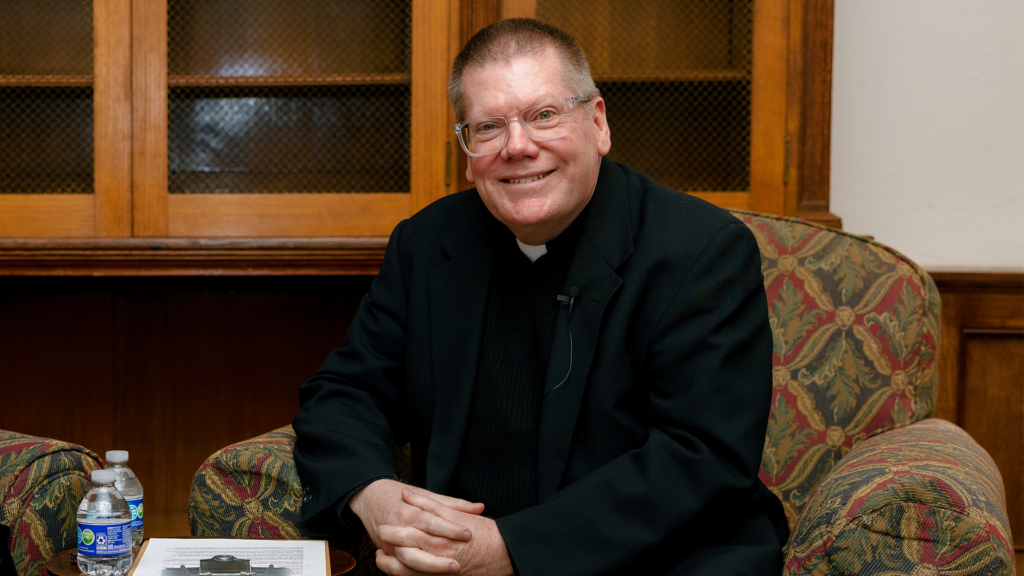
The Good Newsroom is celebrating St. Joseph’s Month by speaking with professors at St. Joseph’s Seminary, the major seminary for the Archdiocese of New York. St. Joseph served as the earthly father and teacher to Jesus during his youth and his apprenticeship in carpentry. He sets an example of work ethic that can still be followed today. We spoke with Reverend Richard Veras, M.A., about the continuing work of translating the Gospel to parishioners through homiletics to continue the Lord’s ministry of evangelization.
St. Joseph was not just an earthly father, but a mentor to Jesus. How should we try to serve as a mentor to those who come to us in need of one?
“Many men who discern the priesthood might not have chosen, of themselves, to become ‘public speakers,’ but their vocation leads them to preach God’s word; and preaching is a particular grace because all that you are comes into play: your prayer life, your knowledge and love of your people, your study of scripture, your temperament and personal history, and every aspect of your own relationship with God.
“The best preacher is someone who is continuously following God’s call with the open heart of a child.”
Homiletics is one of the more public-facing forms of evangelization as well as one of the best-known. How do you prepare your students first for the big stage that a homily provides, and how do you prepare them to use these opportunities to connect with their parishioners?
“The best preparation for a future homilist is to be keenly aware and immensely grateful for the preparation that God has already begun in his life, before he ever entered the homiletics classroom. This includes the mercy He has shown to you, the gifts and graces He gives to you, the struggles He has allowed you to undergo, and the frailties that lead you to depend upon Him.
“In the first weeks of an introductory homiletics class, we consider our life in Christ and how we can discern Christ’s presence in both great and ordinary circumstances of life. St. Paul VI spoke of needing a spiritual sensitivity to the way God speaks to us through events. Pope Benedict XVI spoke of the importance of recognizing God’s active presence in our lives. This is the basis of all preaching because we preach Jesus Christ, who is Risen, present, and active among us.
“If we, ourselves, are able to discern how the Gospel is re-happening in the world and in people’s lives today, this is the greatest way of connecting with parishioners. To be helped to recognize how God is already moving in my life can truly generate me. In a faithfully preached homily, I can recognize God’s loving call which invites me to conversion and to a richer relationship with him and with those he has placed in my life.”
Pope Leo XIV recently spoke on the issue of using AI for homilies. Is this an issue you run into in your class? How do you teach the students to avoid this pitfall?
“I am edified to say that AI has not been an issue in my class. Earlier this year, I asked my students to avoid the temptation of using AI as a substitute for their own necessary preparation, which needs to involve their whole selves as we spoke of earlier. I had not finished getting through my ‘warning’ about AI before the students interrupted me and said, ‘We are not interested in AI for preaching.’ They are great witnesses to me, and they give me great hope.
“Pope Francis calls preaching ‘heart-to-heart communication.’ If the homilist’s heart is not involved, you cannot expect the hearts of the people to be moved. To allow a computer algorithm to replace your own relationship with God and with the people that God entrusts to you would not merely indicate a crisis of preaching, but a crisis of faith.”
Homilies, of course, take their biggest root from Gospel teaching. How do you balance the Gospel’s written message along with the message the homilist wishes to deliver?
“The scriptures each week are given to us by the Church, having been inspired by the Holy Spirit, so every time a preacher looks over the readings for the coming Sunday, it is a moment that God is calling him.
“Pope Benedict XVI and Pope Francis both recommend Lectio Divina as the privileged method to prepare a homily… Lectio Divina is a profound dialogue with God [and] a method of scriptural prayer recommended to all of the faithful, and which is the privileged method of prayer for homily preparation.
“Lectio Divina asks the questions: ‘What does the biblical text say in itself?’ ‘What does it say to us?’ ‘What do we say to the Lord in response to his word?’ ‘What kind of conversion is the Lord asking of us?’ ‘How does this word send me forth to make my life a gift for others?’
“Because of the love that a preacher has for his people, when he comes before the Lord in this prayer of Lectio Divina, his people are there with him because they are in his heart. And the heart-to-heart communication that begins in prayerful preparation will continue in the pulpit.”
How do you try to evangelize in your day-to-day life for those interested in the priesthood?
“There is something similar in each person’s experience of God’s call, and many unique things, as each person is unique. Because of that, I could offer someone an outline of what a path toward the priesthood would look like, but the details are only filled in when one begins to walk the path.
“That God’s call to us is continuous is what makes following a vocation an adventure. I can attest to the great mystery of the adventure, which includes struggles, great joys, and humble gratitude. Regarding evangelization, I can only hope that my own joy and gratitude are manifested in the ways I live my priesthood day to day, and that, when my weaknesses are evident, they do not fully obscure the underlying joy and gratitude.”