

Archbishop-designate Ronald Hicks will be New York’s second leader from Illinois
On Friday, February 6, Bishop of Joliet Ronald A. Hicks will become the 11th Archbishop of New York. He will be the second born in Illinois. Below is a brief introduction to his predecessors.
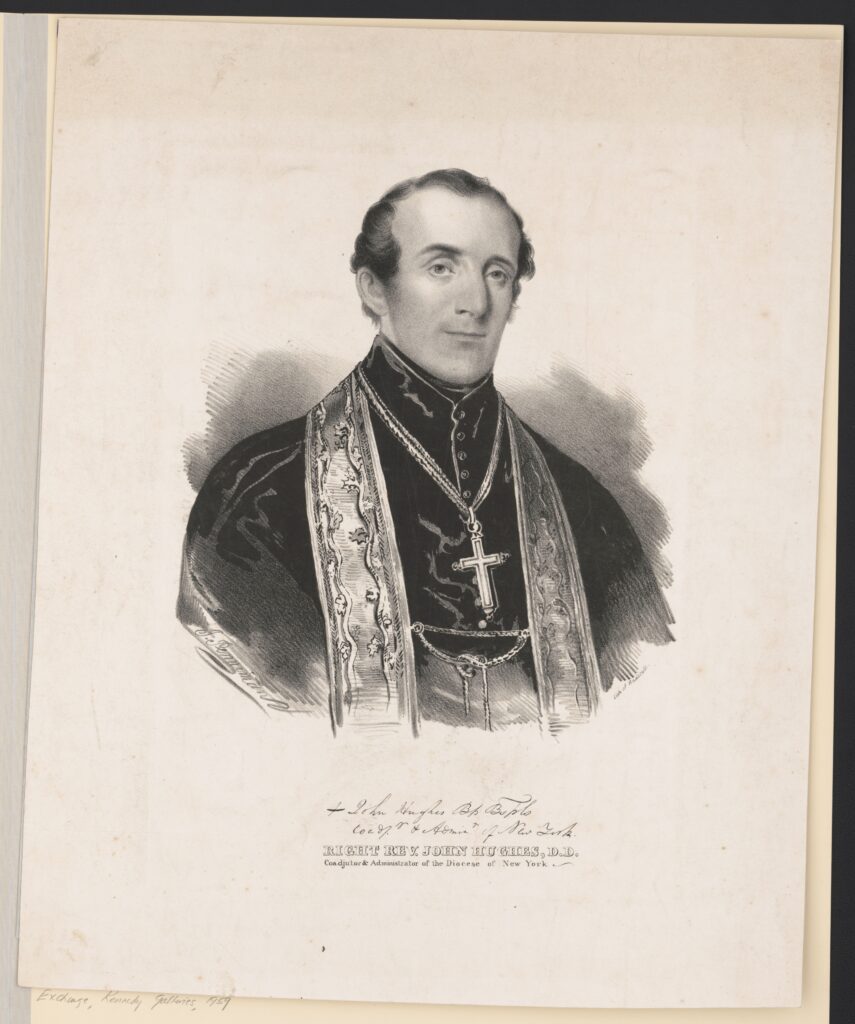
Archbishop John Hughes (Bishop 1842-1850; Archbishop 1850-1864)
John Hughes was born in Annaloghan, County Tyrone, Ireland, in 1798; 20 years later, he fled his native land to escape penal laws that prohibited the practice of Roman Catholicism in Ireland. In America, his brilliance so impressed Mother Elizabeth Ann Seton that she intervened to secure him admission to the seminary at Emmitsburg, where Hughes had been employed as a gardener. At seminary, Hughes came under the tutelage of Father John Dubois, who later became the bishop of New York. Ordained to the priesthood in 1826, Hughes distinguished himself during his early ministry with the eloquence of his defense of the Catholic Church against the forces of nativism in America. Little more than a decade later, Bishop Dubois brought Hughes to serve with him in New York; he succeeded Dubois as bishop in 1842.
Archbishop McCloskey (1864-1885)
When John McCloskey was born in Brooklyn in 1810, there was only one Catholic Church in the New York area, St. Peter’s on Barclay Street in Manhattan. To obtain a Catholic education, he was sent to Mount St. Mary’s Seminary in Emmitsburg, Maryland, where he was tutored by fellow student John Hughes. He was expected to become a lawyer but instead was called to the priesthood and ordained by Bishop Dubois in New York in 1834.
Archbishop Corrigan (1885-1902)
Michael Augustine Corrigan was born in Newark, New Jersey, in 1839 to prosperous parents who had emigrated from Ireland. He graduated from Mount Saint Mary’s College in Emmitsburg, Maryland, in 1859. A member of the first class at the North American College in Rome, he was ordained to the priesthood in September 1863, receiving a doctorate of divinity the following year.
Archbishop Farley (1902-1918)
Born in County Armagh, Ireland, in 1842, John Farley was orphaned at seven. An uncle helped him emigrate to the United States in 1864 and attend St. John’s College, now Fordham University. He began his studies for the priesthood at St. Joseph’s Provincial Seminary in Troy. Sent to continue his studies at the Pontifical North American College in Rome, he was ordained there in 1870. After several years as a parish curate, Farley became secretary to Cardinal John McCloskey; he then served as a pastor before becoming vicar general for the Archdiocese of New York from 1891 to 1902 and auxiliary bishop from 1895 to 1902, when he succeeded Archbishop Corrigan.
Archbishop Hayes (1919-1938)
Born in the Five Points section of Manhattan in 1867, Patrick Hayes was raised by an aunt and uncle after his mother’s death and father’s remarriage. These relatives ran a grocery store where Hayes worked. Destined for more, the young Hayes attended Manhattan College in Riverdale and then entered Saint Joseph’s Seminary in Troy in 1888. Hayes was ordained in 1892 and sent to a parish on the Lower East Side, where he served under John Murphy Farley, whom he would later succeed as Archbishop of New York. Hayes served as Archbishop Farley’s private secretary from 1895 to 1903. Later, he was appointed Chancellor of the Archdiocese and Rector of the Cathedral College.
Archbishop Spellman (1939-1967)
Born in rural Whitman, Massachusetts, in 1889, Francis Spellman was educated in local public schools. After graduating from Fordham University in the Bronx in 1911, Spellman decided to study for the priesthood at the Pontifical North American College in Rome. During his studies, Spellman befriended several men who would rise to leadership positions in the Church, most notably the future Pope Pius XII.
Archbishop Cooke (1968-1983)
Terence Cooke was born to immigrants from Galway in Morningside Heights and raised in the Northeast Bronx. He expressed an early interest in the priesthood and entered the minor seminary of the Archdiocese of New York in 1934. In 1940, he entered St. Joseph’s Seminary in Yonkers and was ordained by Cardinal Spellman five years later.
Archbishop O’Connor (1984-2000)
Born in 1920 in Philadelphia, John O’Connor attended public schools until his junior year of high school, when he enrolled in West Philadelphia Catholic High School for Boys. St. Charles Borromeo Seminary followed, and he was ordained a priest for the Archdiocese of Philadelphia in 1945. For the following seven years, he served as a parish priest.
Archbishop Egan (2000-2009)
Edward Egan’s childhood was stereotypically mid-century American. Born in 1932 in Oak Park, Illinois, he was several generations away from a hardscrabble immigrant experience; his father was a sales manager and his mother, a homemaker. He contracted polio, then a relatively common disease, and missed two years of school. Realizing his vocation, Egan entered Saint Mary of the Lake Seminary and completed his studies for the priesthood at the Pontifical North American College in Rome. After ordination in 1957, he rose rapidly through the ranks of the Archdiocese of Chicago. He also served in Rome before becoming auxiliary bishop of New York in 1985 and bishop of Bridgeport, Connecticut, in 1988. In 2000, he was appointed to succeed Cardinal O’Connor and became a cardinal himself in 2001.
Archbishop Dolan (2009-2026)
Growing up in St. Louis, Missouri, where he was born in 1950, Timothy Dolan exhibited a strong interest in the priesthood from an early age, saying, “I can never remember a time I didn’t want to be a priest.” After receiving his baccalaureate degree, he continued his studies in Rome at the Pontifical North American College. Ordained in 1976, his resume includes further studies, pastoral work, and diocesan administration. He became the auxiliary bishop of St. Louis in 2001 and Archbishop of Milwaukee, Wisconsin, in 2002.
Archbishop Hicks (2026-)
Ronald Aldon Hicks was born in Harvey, Illinois, in 1967, and raised in South Holland, where he attended St. Jude the Apostle Parish and grade school. After graduating from Quigley Preparatory Seminary South, he earned degrees from Niles College of Loyola University and the University of St. Mary of the Lake. Ordained to the priesthood for the Archdiocese of Chicago in 1994, Hicks served in parish ministry and as dean of formation at St. Joseph College Seminary before spending five years in El Salvador as regional director of Nuestros Pequeños Hermanos, caring for orphaned and abandoned children across Latin America. Returning to Chicago, he was appointed vicar general of the archdiocese by Cardinal Blase Cupich in 2015. Pope Francis ordained him an auxiliary bishop of Chicago in 2018 and appointed him the sixth bishop of Joliet, Illinois, in 2020, where he served until being named the 11th Archbishop of New York on December 18, 2025.
—
This article was compiled with information from and courtesy of Saint Patrick’s Cathedral.