



The Pallium Pilgrimage to Rome: A New York Pilgrim’s Perspective
By: Mary Kate Polanin
It’s heartening, as this particular period of transition for our archdiocese symbolically ends with the pallium liturgy, to witness firsthand how succession and passing on are inherently part of the Church’s DNA
For the past five days, more than 150 pilgrims from New York and Illinois have had the opportunity to attend Mass at the four major basilicas in Rome with Archbishop Ronald Hicks, who was there to receive his pallium from Pope Leo XIV. As just one of those pilgrims, I found myself visually drawn to a particular theme: where the old meets the new.
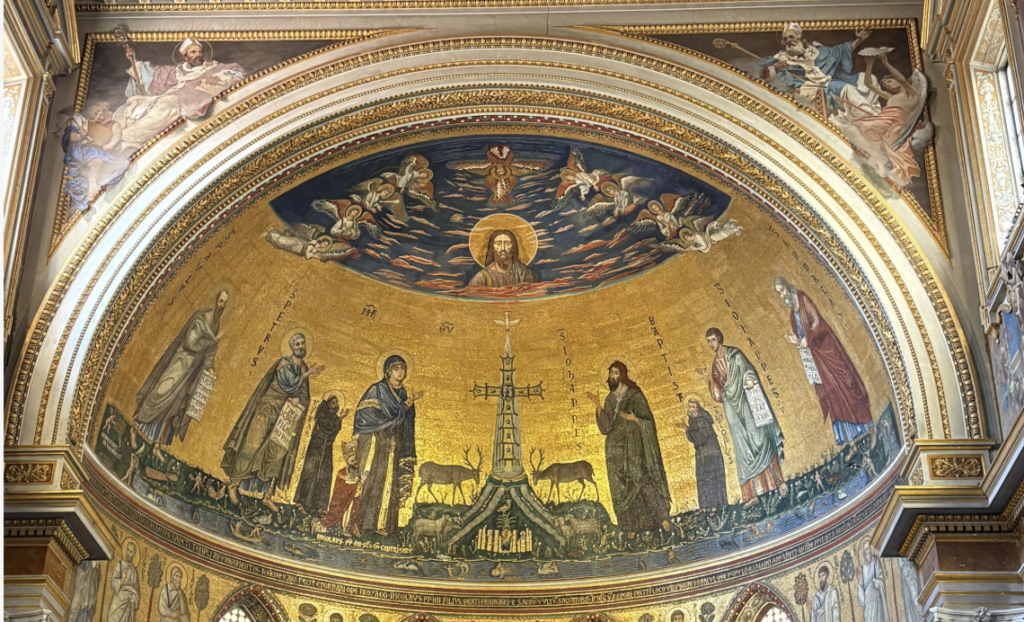
Standing in the nave of the Archbasilica of St. John Lateran, I watched Archbishop Hicks consecrate the Eucharist at the altar. Looking down on him and the concelebrants from the apse were the four Evangelists. I was struck by how the two images resonated: the 11th archbishop of New York proclaiming the very Gospel written by those depicted above him.
As the days went on, that theme of where old meets new continued, not only in the masterful art and architecture throughout the city, but also within our own group of pilgrims. While New Yorkers had come to support their new archbishop, parishioners, family, and friends from Illinois affectionately shared their own memories of “Bishop Ron.” One pilgrim, Joy, had even known him as a college student when they studied abroad together in Rome.
In meditating on these different eras and experiences, I could see the Church’s emphasis on unity and tradition at work.
Watching the Pallium Mass from the press box at St. Peter’s Basilica, I saw the symbolic unity between the pope and metropolitan archbishops come to life as Pope Leo XIV imposed the pallium on Archbishop Hicks’ shoulders. The two sons of Illinois, standing in St. Peter’s Basilica, above the Apostle’s tomb, joyfully embraced and exchanged a few words.
Later, at the reception hosted by the Pontifical North American College, Cardinal Timothy Dolan, archbishop emeritus of New York, reflected on the continuity of apostolic leadership and the beginning of a new chapter under his successor. He credited the Latin word “traditio” as a way of expressing how the Church goes on, and must do so for its own longevity.
In his homily at the Mass of Thanksgiving, Archbishop Hicks expressed his gratitude for the support he’d received through the pilgrimage. He also cast an image of hope for the future, referring to the gospel reading in which Jesus calmed the seas while out on the boat with his disciples. Jesus does not promise calm waters, Hicks affirmed, but he does promise to be with us, always.
It’s heartening, as this particular period of transition for our archdiocese symbolically ends with the pallium liturgy, to witness firsthand how succession and passing on are inherently part of the Church’s DNA. So much so that, if you ever have the chance to visit the Basilica of St. Paul Outside the Walls, you’ll see that among the long row of portraits depicting each successor of Peter, all the way through Pope Leo XIV, are empty outlines just waiting for the next pope. Rather than clinging to the past, the Church plans for and expects new leaders to emerge and carry on its mission to go out and make disciples.