



What the Pope's New Encyclical on AI Is Asking of You
By: OSV News
Pope Leo XIV’s “Magnifica Humanitas” isn’t just a statement, it’s a call to action, and it comes with specific marching orders for Catholics
Near the end of his new encyclical “Magnifica Humanitas,” Pope Leo XIV senses that his reader may be feeling overwhelmed. “At this point,” the Holy Father writes, “a subtle temptation may emerge, namely the thought that the problems are too big and we are too small, and that our choices, therefore, cannot make a difference.”
And here he turns to, of all people, J.R.R. Tolkien and “The Lord of the Rings”: “It is not our part to master all the tides of the world, but to do what is in us for the succor of those years wherein we are set, uprooting the evil in the fields that we know, so that those who live after may have clean earth to till.”
The Holy Father just quoted Gandalf in an encyclical. And it was pitch perfect.
AI’s threats are already here
If you don’t yet understand why a pope would feel the need to offer that kind of reassurance, then you aren’t paying close enough attention to what AI is doing and may do to our world.
Many have heard that this new technology threatens to displace all sorts of workers, but such a threat, as real and profound as it is, is by no means the only one. The U.S. Department of War has sued an AI company to make sure it can create autonomous weapons which kill without any human oversight.
AI-generated child pornography is now one of the fastest-growing categories of online content. This is not a future problem. This is a new problem.
Inside Anthropic’s engagement with the Church
Over the past few months, I have had the privilege of getting to know several people at Anthropic, including via two convenings at their San Francisco headquarters for Christian scholars and leaders.
During these months, I developed a friendship with Chris Olah, one of Anthropic’s co-founders, and the same person who stood alongside Pope Leo at the Vatican press conference to mark the encyclical’s release and called for critical dialogue and cooperation between the Church and the AI industry.
I can tell you with confidence that he means it. There is a great mystery underlying the nature of what it is they are building, and the worries Chris and others have about what the future may hold as AI systems get exponentially more powerful quite rightly keep them up at night.
Their existential fears and their need for help underscore why the encyclical matters so much.
Three foundations of Leo’s argument
Leo builds his argument on three foundations that Catholics should sit with carefully. The first is that something genuinely new is happening here. AI is not just a faster calculator or a smarter search engine. It “challenges the categories of Social Doctrine from within,” the encyclical says, in ways that require not just new applications of old principles but the development of those principles themselves. Human dignity is under a threat that we have not faced before, and Leo knows it.
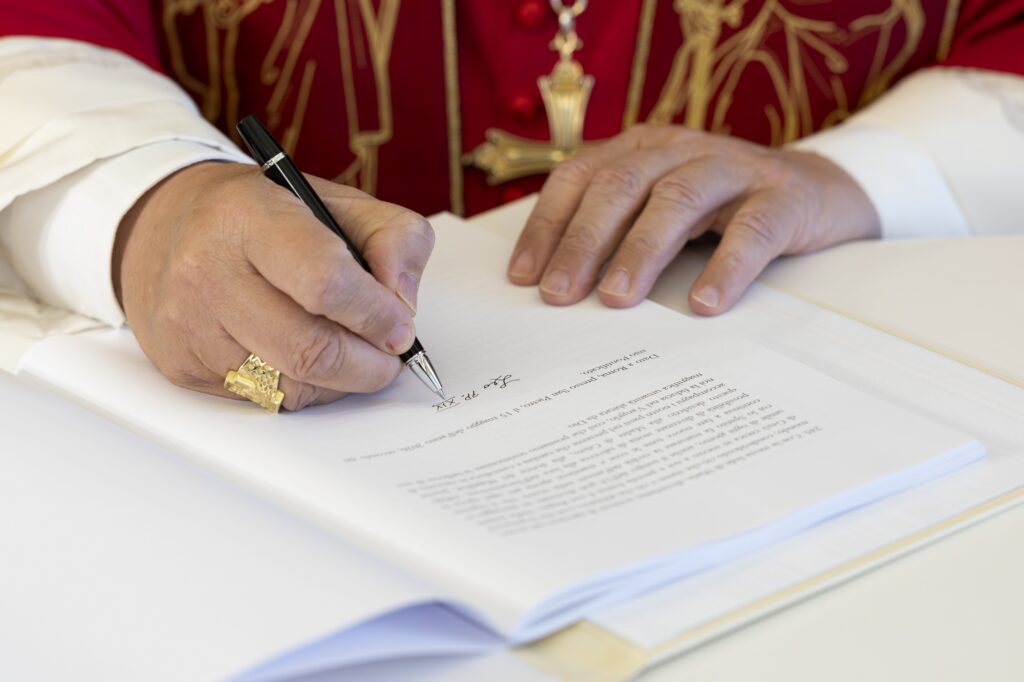
The second is that labor should be at the heart of our concern. Leo XIV signed “Magnifica Humanitas” on the 135th anniversary of “Rerum Novarum,” Leo XIII’s great encyclical on behalf of workers being ground up by the previous industrial-technical revolution.
That anniversary is not rhetorical decoration. The new encyclical insists that work is “a fundamental good for the person, a principle of economic activity and the key to the entire societal question.” When AI systems mass-displace workers in the service of being more efficient and extracting more profit, this constitutes a foundational attack on human dignity.
Work, says Leo, is not merely an instrument or a source of income; on the contrary, “it expresses and enhances the dignity of our lives.” The pope calls work “a requirement of the human condition,” and he quotes the U.S. bishops who insist that it provides “a crucial sphere in which identity is formed, friendships and relationships are forged, practical responsibilities are learned, and one’s vocation is discerned.”
The Church’s unique role at a hinge moment
The third is that the Church has a unique and urgent role to play at this hinge moment in history. Leo quotes his predecessor, Pope Francis, directly: “No one can demand that religion should be relegated to the inner sanctum of personal life, without influence on societal and national life, without concern for the soundness of civil institutions, without a right to offer an opinion on events affecting society.”
The Church is the guardian and promoter of a 2,000-year tradition of thinking about what human beings are and what they are for. That tradition, not least because it has navigated these kinds of dramatic moments in the past, is exactly what we need right now. And the fact that some of the most important AI researchers in the world are actively engaging in it should give added confidence to act in light of our tradition.
What Pope Leo is asking of you
But what, specifically, is Leo asking of us?
First, he is channeling his inner St. John Paul II in urging us not to be afraid to spread the good news in the midst of the AI revolution. “I encourage all members of the Church not to be afraid of the present challenges,” the Holy Father says. The truth which the Church has to offer at this historical moment “is a gift to be shared” with the world.
Second, he is asking us to begin with ourselves. The encyclical returns repeatedly to the following question: Does this technology “make human life on earth ‘more human’ in every aspect of that life? Does it make it more worthy of man?” That question, first, is a personal one. How am I using AI in my own life? What habits is it building or eroding in me? Am I using it in ways that deepen my attention and my relationships, or in ways that outsource my judgment and thin out my humanity? We must evangelize ourselves before we bring this message to the world.
Third, he is asking us to get to work. The biblical image Leo returns to again and again is Nehemiah rebuilding the walls of Jerusalem: Everyone is given their own section. Scientists and researchers. Entrepreneurs and workers. Educators and legislators. Faith communities. Each in their own field, doing what is in them to do.
Perhaps you are being called to organize a labor union for workers in your school or hospital? Especially if you work in a Catholic institution, perhaps you are being called to ask, right now, whether anyone has evaluated the AI tools your institution is adopting, and against what criteria. The encyclical gives you both the standing and the obligation to ask that question. If no one is asking it, then this may be your section of the wall to get started on.
Leo writes: “The civilization of love will not arise from a single or spectacular gesture, but from the total of small and steadfast acts of fidelity.”
We have our marching orders. Time to get to work.
—
Charles Camosy is a contributor for OSV News.