



Founded in 1900, the society continues its mission of making Catholic materials accessible to the visually impaired
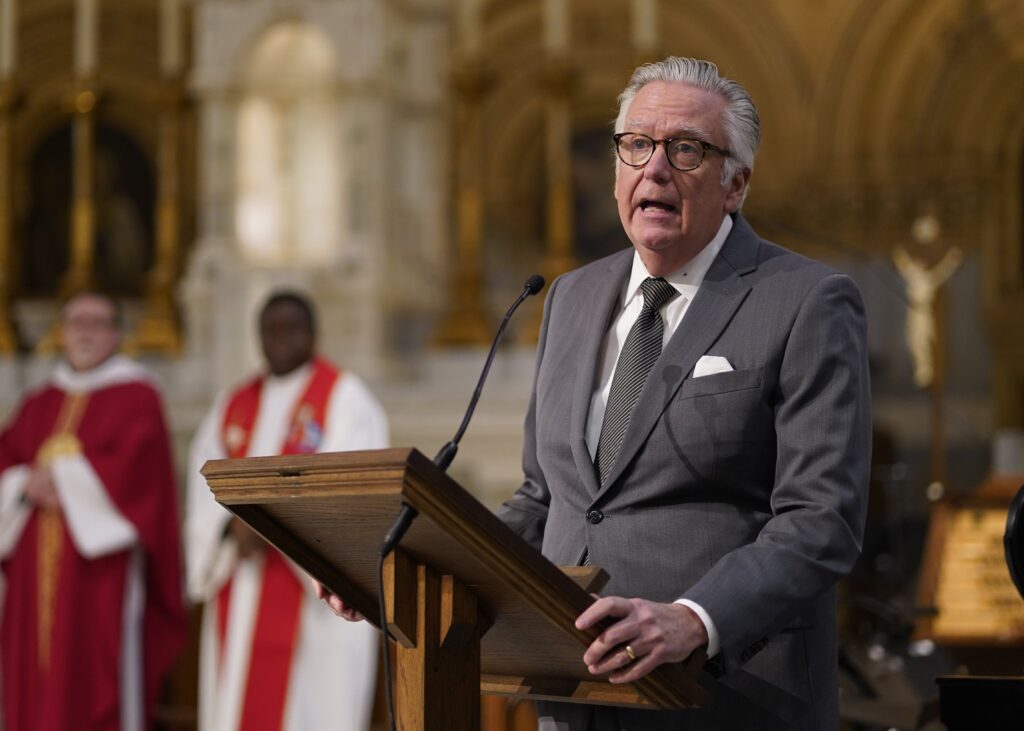
For 125 years, the Xavier Society for the Blind has pursued a singular mission: ensuring that blind and visually impaired Catholics have the same access to their faith as their sighted peers. On December 14, the organization celebrated its milestone anniversary with a Mass at St. Patrick’s Cathedral, marking more than a century of vital service.
“That’s what inspired Margaret Coffey and Father Joseph Stadelman to start our mission 125 years ago,” Malachy Fallon, executive director of the Xavier Society for the Blind, told The Good Newsroom in a telephone interview. “So, things have changed in the way we produce braille, but it still is at the heart of our mission.”
The anniversary Mass, celebrated by Cardinal Timothy Dolan along with Father Jamie Dennis, a blind priest from Kentucky who serves as one of the society’s patrons, coincided with the feast of St. Lucy, patron saint of the blind.
The cost and necessity of accessibility
At the heart of the Xavier Society’s work is producing Catholic materials in braille, large print, and audio formats, all provided free of charge. The society’s newly updated braille Bible spans 30 volumes and costs approximately $1,700 to produce each set.
“Not only is it expensive, but these books, these materials are not available in braille from any other source,” Fallon explained. “So, it’s not just a matter of cost, it’s a matter of availability. That’s why I think our mission has endured for 125 years.”
The organization produces everything from Mass propers to complete Bibles, and contemporary works like Pope Francis’s recent autobiography, “Hope”. Production costs can run several thousand dollars between transcription and embossing, the technical term for printing braille on paper.
While technology has transformed how the Xavier Society operates, from the original New York Point raised print to modern braille, the fundamental mission remains unchanged. “Rather than doing everything in-house now, we work with quite a few freelance transcribers to make sure that we can fulfill all the requests that we receive from our patrons,” Fallon said.
Adapting technology while preserving tradition
The organization partners with the National Library Service for the Blind and Print Disabled to ensure its audiobooks can be downloaded through the BARD smartphone app. “We want to ensure that it’s as good as Audible,” Fallon said. “And that’s the other thing, if something is available on Audible, we won’t produce it because, you know, why duplicate efforts and use our resources to create something that’s already available?”
Yet certain materials are better suited to different formats. Mass propers, which people want to bring to church, are produced in braille and large print rather than audio.
The reintroduction of large print materials has proven particularly significant. “We reintroduced large print, both the Bible in large print and the Mass propers in large print, because many of our patrons, as they age, they’re experiencing sight loss, but they’re not going completely blind,” Fallon said.
The importance of braille literacy
As debates continue in the blind community about whether braille literacy remains necessary in an age of screen readers and text-to-speech technology, Fallon is unequivocal about its importance.
“Reading braille for a blind child is the same as reading a book for a sighted child, right?” he said. “It’s very important for their intellectual development and their ability to learn, retain, understand what they’re reading.”
Unemployment rates among people who are blind remain significantly higher than those of the general population, making the society’s free distribution model crucial. “Everything that we provide to our patrons, we provide free of charge,” Fallon said. “So, we rely on our fundraising and donations from foundations, from a number of Catholic and Catholic-affiliated foundations, and foundations that have an affinity for organizations that provide services to people with disabilities.”
Looking ahead to the future
Fallon sees the next 25 years focused on expanding outreach and partnerships. The society recently moved into new office space with the JBI Library, formerly the Jewish Braille Institute. “Looking for opportunities to partner, not only with JBI but with other organizations across the country and around the world, to do what we do better and reach more people.”
“What we do helps people of faith, mostly Catholics, learn about, develop, and practice their faith,” Fallon said. “I always say Father Jamie is an embodiment of our mission. So, it shows how our mission allows blind and visually impaired Catholics to actively practice their faith, which is really, really important to us.”
The society’s board reflects the community it serves, including blind members like Vice President Skylar Kovacic and Maribel Mera, who leads the office of ministry for the deaf and disabled with the Archdiocese of Washington, D.C.
“We can’t do it without the generosity of our benefactors,” Fallon said. “Everything that we do, everything we provide, we provide free of charge, which is unheard of these days, especially for an organization that’s been around for 125 years.”