

America250: Venerable Pierre Toussaint
By: The Good Newsroom
How a Haitian-born hairdresser became a spiritual father of Catholic charitable work in New York
The story of Pierre Toussaint begins not in Manhattan or even the American colonies, but in Haiti, a French colony when he was born, enslaved, in 1781, although some sources give his birth year as 1766 or 1776.
Toussaint was born into the ownership of the Bérard family, which owned a plantation. Over the next 30 years, despite his enslavement, Toussaint was raised in the Catholic faith and received an education. He moved with the Bérard family first to France and then to Manhattan in 1797.
Although the American Revolution had ended years earlier and the United States had become an independent nation, slavery was still not only legal in New York, but the state held the highest concentration of enslaved people of any northern state, including the newly arrived Toussaint.
Apprenticed as a hairdresser
Still enslaved, Toussaint was apprenticed to become a coiffeur, or hairdresser, an emerging profession. He found early success handling the complex hairstyles of the time and addressing the regular upkeep they required. He was permitted to keep part of his earnings, according to a 2024 New York Times article. His clients included wealthy New York women such as Eliza Hamilton, wife of Alexander Hamilton, the former U.S. Treasury secretary and, by 1799, the nation’s top military officer.
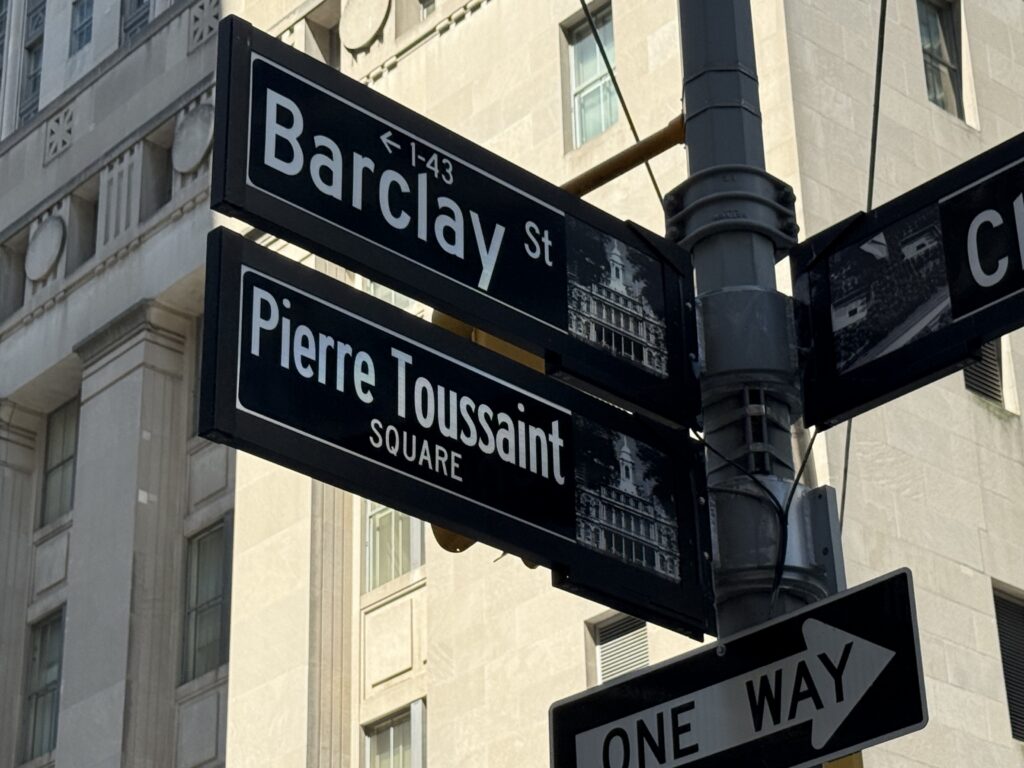
After arriving in Manhattan, Toussaint became a parishioner at St. Peter’s Church on Barclay Street, the oldest Catholic church in what is now the Archdiocese of New York.
Jean Bérard, Toussaint’s owner, died in 1801, and political turbulence in Haiti left the widow Marie Bérard in financial distress. Although still enslaved, Toussaint is known to have supported the household with earnings from his growing business. Marie died in 1807, finally granting Toussaint his freedom upon her death.
Although he had gained his freedom, slavery would not end completely in New York until July 4, 1827.
In “Memoir of Pierre Toussaint,” written in 1853 by Hannah Farnham Sawyer Lee, Toussaint recalled his experience with slavery. When a lady once asked Toussaint whether he was an abolitionist, the memoir records that “he shuddered, and replied, ‘Madame ils n’ont jamais vu couler le sang comme moi,’ ‘They have never seen blood flow as I have’; and then he added, ‘They don’t know what they are doing.'”
The memoir later recalls, “Though surrounded in New York by free men of his own color, he said that he was born a slave — God had thus cast his lot, and there his duty lay.”
A home that welcomed the marginalized
Once Toussaint was finally free, he and his new wife, Juliette, whose freedom he purchased along with that of his sister, Rosalie, could easily have focused on themselves, building a comfortable life. Instead, their home became more like a refuge, open to orphans, the sick, and anyone who needed a place to land, regardless of their race or standing.
As his hairdressing work brought in more money, Toussaint funneled much of it toward New York’s poor, helping fund orphanages, supporting the city’s earliest Catholic charitable efforts, and even contributing to the construction of the first St. Patrick’s Cathedral on Mulberry Street.
Many historians and Church leaders now consider Pierre and Juliette among the founding figures behind Catholic Charities in New York. “They had wealth enough for their own enjoyment, and to impart to those who were in want. They were conscientious Catholics; charity was for them, not only a religious duty, but a spontaneous feeling of the heart,” the “Memoir” stated.
Faith lived daily, honored eternally
Toussaint’s wealth and his reputation for generosity earned him respect among New York’s elite, but what really set him apart was something simpler: consistency.
He attended Mass faithfully, year after year, with a regularity people noticed and remembered. “He was observant of all the forms of the Roman Catholic Church; through winter and summer he missed no matin prayers, but his heart was never narrowed by any feeling as to sect or color,” the “Memoir” noted.
His final recorded words came in response to a question about whether he needed anything: “‘Dieu avec moi,’ ‘God is with me.’ Asked again, he answered with a smile, ‘Rien sur la terre,’ ‘Nothing on earth,'” the “Memoir” states.
Upon his death in 1853, Toussaint, who likely took his surname from the leader of the Haitian Revolution, was buried in the yard of Old St. Patrick’s Cathedral, next to his wife, who had preceded him in death. In 1990, his remains were moved to the crypt underneath the altar of St. Patrick’s Cathedral, where he remains the only layperson. He is memorialized with a portrait that hangs behind the altar of the cathedral.
Father Enrique Salvo, rector of St. Patrick’s Cathedral, said in an earlier interview with The Good Newsroom that Toussaint “was someone that gave back with everything because he was a man of faith.”
A cause for canonization moves forward
The effort to formally recognize Toussaint’s holiness has been underway for decades now, and it’s still moving, even if slowly. The Vatican opened his case for sainthood in 1996, and since then he’s reached the rank of Venerable, the second of four steps on the path toward canonization.
According to Father Salvo, the next stage usually involves miracles: people praying for Toussaint’s intercession and seeing results. He has said he hopes more people will turn to Toussaint in prayer when they’re in need.
A portrait of Toussaint was first unveiled in 2023 at the annual dinner for the Pierre Toussaint Scholarship Fund, and Cardinal Timothy Dolan blessed it not long after, following a Sunday Mass.