



‘Graphic Devotions’ Exhibition at Morgan Library Shows Medieval Illustrations of Biblical Stories
By: Patrick Grady
From late medieval Europe, these blockbooks give insight into how those interested in deepening their faith viewed depictions of biblical stories when this medium of illustrated literature was still in its infancy
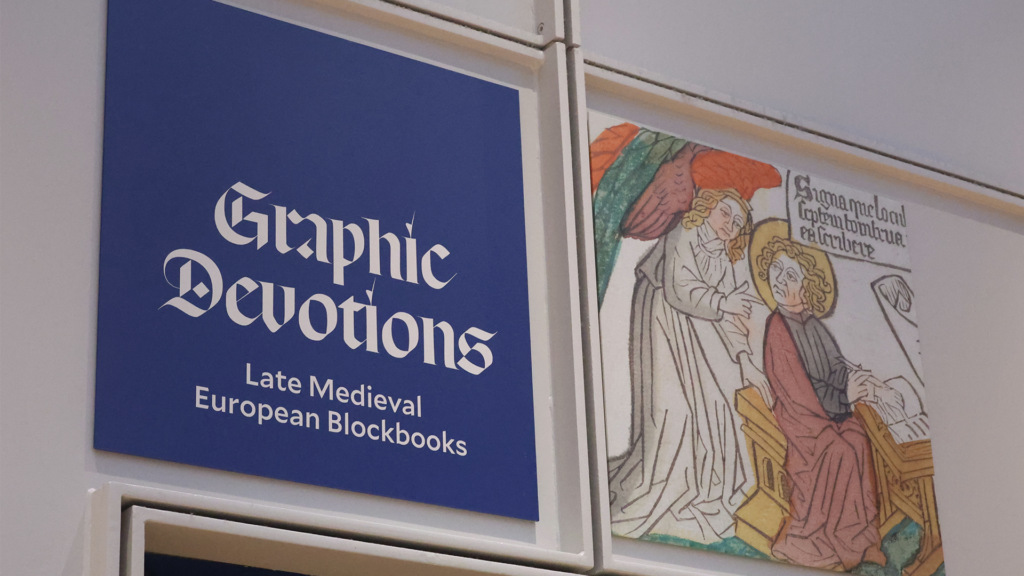
The Morgan Library and Museum opened “Graphic Devotions: Late Medieval European Blockbooks” on Nov. 6, an exhibition of medieval books that functioned as an early form of comic books or graphic novels. The works date to a time when books were becoming far more common in the homes of everyday people, and they gave the devout a way to see how Bible stories may have looked.
Like most early printing, the blockbooks offered new editions of biblical texts. John McQuillen, the exhibition’s curator, told The Good Newsroom in a phone interview that Scripture was a natural showcase for new mediums because of its reach.
Revelation inspires medieval artists
“Christian works had the broadest reach. You would have the biggest and broadest audience across Europe for that. That’s why I think Gutenberg, when he was developing the printing press, why he chose to print a Bible, because that was going to be your best marketing… I think the craftspeople printers who were behind converting manuscripts and other printed texts or inventing texts in block book, they’re looking at this large market of Christian devotion,” McQuillen said.
The Book of Revelation, with its vivid symbols and descriptions of the end times, captured the imaginations of artists of the period, and many pieces in the exhibition depict its major moments. Excerpts from “Ars moriendi,” “The Morgan Apocalypse,” and “Apocalypsis sancti Johannis” line the walls and cases, showing prominent images such as the four horsemen of the apocalypse, the beasts that brought on the end times, and the Last Judgment.
“The Morgan Apocalypse” is a celebrated work in art history circles, and McQuillen spoke about what makes it special.
“We have a number of manuscripts and other artworks in the collection that are in like every art history 101 textbook… it’s one of the earliest, but kind of one of the most beautifully done because it does have expensive lapis lazuli coloring and gold. It’s very much intended for an upper echelon audience. It’s also one of the earliest and just a very clear example for even in the thirteenth century of the importance of visualizing the apocalypse in this way. The perpetual anxiety or expectation that the end times were coming any day now. So, there was a need to always be somewhat prepared,” he said.
The ‘Biblia pauperum’ triptychs
The back wall of the exhibition is devoted to the “Biblia pauperum,” or Bible of the Poor. The name refers not to those in financial poverty but to those in need of theological enrichment. The examples on display are triptychs, each joining three connected stories that range from the Old Testament to Revelation and link events across time and place. One connects “Melchizedek offers bread and wine,” the “Last Supper,” and “Moses and the manna from Heaven,” showing the importance of meals that came to be known as the body and blood of Christ throughout biblical times.
The Morgan holds the largest collection of blockbooks in the United States and often calls them “medieval graphic novels” for simplicity’s sake. They capture a moment when machine printing was still new, and handwriting had to compete with each new medium to share words and traditions.
“Graphic Devotions” is on view through May 16, 2027, alongside the museum’s other exhibitions. Visitors may also want to see “Rembrandt’s Lions: Art and Exile in the Dutch Republic,” which features the Dutch master’s pieces on Christ’s passion, including the famous “Three Crosses,” depicting three different versions of Christ’s crucifixion between two thieves.