



Archbishop Ronald Hicks Tours 9/11 Museum and Memorial, Visits Engine 54
By: Steven Schwankert
John Cahill, chancellor of the Archdiocese of New York and founding board member of the National September 11 Memorial and Museum, guided the archbishop through the attack site’s exhibits and grounds
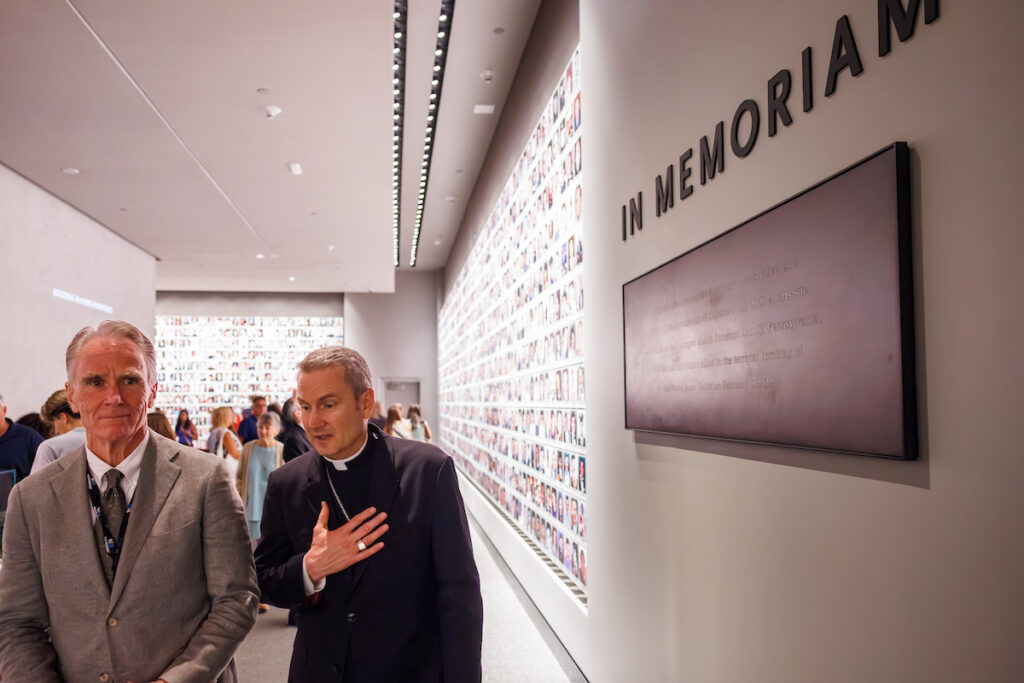
Archbishop Ronald Hicks toured the National September 11 Memorial and Museum on Sunday, followed by a visit to a Midtown fire department company that suffered significant losses during the World Trade Center collapse.
The archbishop celebrated the 10:15 Mass at St. Patrick’s Cathedral, which was quietly attended by New York City Mayor Zohran Mamdani. The archbishop and the mayor shook hands and exchanged pleasantries at both the beginning and end of Mass.
During his homily, Archbishop Hicks focused on the theme of conflict resolution and how Jesus and the Church expect us to handle it.
“Wherever people gather, there will always be conflict,” he said. Jesus’ way is to listen, the archbishop said.
“If there is conflict, first go and talk to the person. If not, add two or three others to the conversation. If not, then bring it to the Church,” Archbishop Hicks said, citing the day’s gospel.
“We must be willing to first, listen,” and both the faithful and the Church must have “the humility to listen.”
Returning to Ground Zero
Following Mass, Archbishop Hicks joined John Cahill, chancellor of the Archdiocese of New York and founding board member of the National September 11 Memorial and Museum, for a tour of both the museum and other sites on its grounds, including the two pools ringed with the names of those lost, known as “Reflecting Absence,” where the World Trade Center’s north and south towers stood, and the Survivors’ Tree, a pear tree found living in the rubble at Ground Zero that was cared for and then returned to the site.
Cahill called attention to and illuminated numerous displays and artifacts of interest, including a Bible page fused to a piece of steel, with legible text from Matthew 5. He also explained that the famous steel cross, two beams that were found by workers on Sept. 13, 2001, was displayed at the museum after having faced a legal battle over its public display before being moved to the museum in July 2011.
“It’s impactful every time. And each time I visit, it continues to touch my heart and help me understand the importance of memory, remembering, honoring, and being a people of resilience, of peace, and of prayer,” he told The Good Newsroom in an interview after the visit. The archbishop had visited the museum twice previously as a tourist, before moving to New York. Archbishop Hicks was still a seminarian at Mundelein Seminary at the University of Saint Mary of the Lake in Illinois in 2001 when the attacks took place.
“I stopped at a number of places simply to pray, to pray for all those who were affected in the past, to pray for our world today, for peace, and to pray for our future. What kind of world are we going to hand down to our children? All of that was stirred up today by this visit,” Archbishop Hicks said.
He expressed hope for healing and peace during the coming week. “As we prepare for this upcoming commemoration of 9/11, I think it’s to remind us that peace is fragile. Peace is fragile. Don’t take it for granted, and work for it. Be a part of the solution. And for me, as the spiritual shepherd, it’s to continue to pray for it.”
Both inside and outside the museum, Archbishop Hicks was recognized by New Yorkers and by visitors from other parts of the country. A group of young men from the Ohio State University, who had also brought up the offertory during the 10:15 Mass, saw the archbishop and asked for a photo and a blessing, with Archbishop Hicks happily obliging.
“Welcome to the neighborhood”
Heading back to Midtown Manhattan, Archbishop Hicks stopped to visit the firehouse of Engine 54, Ladder 4, Battalion 9 on Eighth Avenue, known as the “Pride of Midtown.” Engine 54 lost 15 of its firemen on 9/11, each of whom is memorialized on a wall of remembrance at the firehouse’s entrance.
“Welcome to the neighborhood,” the firefighters wished Archbishop Hicks as he entered. Engine 54 serves an area that includes St. Patrick’s Cathedral and the archbishop’s residence, along with the Theater District. It is considered Manhattan’s busiest fire unit. Many will attend Mass on Sept. 11 at St. Patrick’s, they said.
After hearing about Engine 54’s history and seeing the firehouse’s kitchen and dining area and its two trucks, Archbishop Hicks prayed with and blessed the firefighters present. He took photos with the men before returning to the residence.