



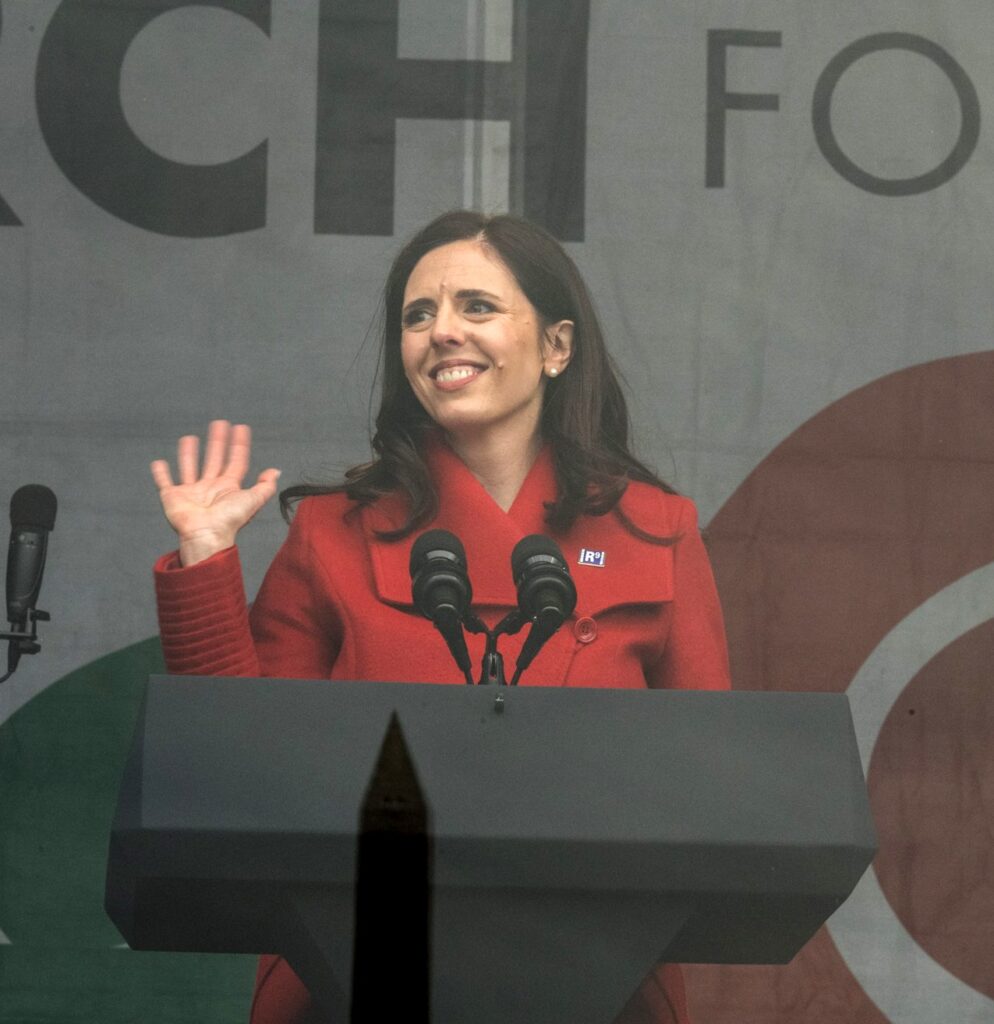
WASHINGTON (OSV News) — A “complex” political environment presents both challenge and opportunity for the pro-life movement, Jennie Bradley Lichter, president of the March for Life Education and Defense Fund, said at the 27th annual Cardinal O’Connor Conference on Life on January 24.
“We shouldn’t kid ourselves that everything is rosy and we shouldn’t be too quick to pat ourselves on the back,” she said in a keynote address at the conference. “Abortion rates have actually been rising with the rise of the chemical abortion pill and how easily it’s accessed; our culture is still deeply unfriendly to life.”
The conference, organized by students at Georgetown University, gathered under the theme “The Pro-Life Mission After-Birth: A Lifelong Devotion.” The Cardinal O’Connor Conference is typically held the day before or after the annual March for Life, according to the university. It was first held in 2000 and later named in honor of the late Cardinal John J. O’Connor, who was archbishop of New York, a Georgetown University alumnus, and founder of the Sisters for Life. Cardinal O’Connor was known for his pro-life activism on abortion, but also for his opposition to the death penalty and his support for social safety net programs.
In her address, which came the day after her first national March for Life at the helm of the organization, Lichter told the conference that the pro-life movement needs to win converts to its cause.
“We can never compromise our position, which is rooted in the truth about human life,” she said. “But how do we adjust our framing and our messaging so that our fellow Americans can hear and understand it, can receive it?”
Frustration amid political shifts
The conference this year, and the March for Life itself, took place amid growing frustration from some in the pro-life movement about what they see as inaction from the Trump administration on key policy priorities like stronger restrictions on mifepristone, a pill commonly but not exclusively used for early abortion, and protecting the Hyde Amendment, which prohibits public funding of elective abortions.
Vice President JD Vance addressed the 53rd annual March for Life in Washington January 23. Acknowledging in his comments what he called “the elephant in the room,” Vance spoke about concerns from some in the pro-life movement about their remaining policy priorities just over a year into Trump’s second term in the White House.
“I want you to know that I hear you, and that I understand there will inevitably be debates within this movement,” Vance said in his address. “We love each other, and we’re going to have open conversations about how best we use our political system to advance life, how prudential we must be in the cause of advancing human life. I think these are good, honest and natural debates, and frankly, they’re not just good for all of you. They help keep people like me honest, and that’s an important thing.”
The comments from Vance, and from President Donald Trump, who addressed the rally by pre-recorded video message, came shortly after pro-life leaders criticized Trump’s comments to House Republicans January 6 telling them to be “flexible” on the Hyde Amendment in negotiations on health care subsidies, to the disappointment of pro-life groups that have long supported that policy.
Pro-life leaders have also objected to a September decision by the Food and Drug Administration, which operates under the Department of Health and Human Services, to approve Evita Solutions’ generic version of mifepristone. The drug’s approval came despite previous indications from FDA and HHS officials that mifepristone would undergo a safety review. On its website, Evita Solutions calls mifepristone “an effective, safe way to terminate early pregnancy.” It was also the second time a Trump administration approved a generic pill for abortion, which it did in 2019.
Some pro-life groups have called on the Trump-Vance administration to roll back the Biden administration’s actions on mifepristone to what was in place during the Trump-Pence administration.
Seizing opportunities in challenging times
Lichter told the conference, “right now, this moment, our particular American moment, is full of opportunity, and it’s full of challenges for those of us who care about the rights of the unborn and about making sure that moms have the support they need to choose life.”
Although there is a “very politically complex dynamic” surrounding “the current president and the 2024 election,” Lichter argued, she said that “one really important takeaway for our purposes is that (former Vice President) Kamala Harris, of course, built her campaign around abortion rights.”
“She and her campaign managers and the Democrats made a big bet that the American people’s desire for unfettered abortion on demand through all nine months of pregnancy was going to propel her into office in the wake of the Dobbs decision, and they were wrong,” she said. “That is not what the American people wanted.”
However, she argued, “the cultural and political landscape for the pro-life movement is challenging, no doubt about it, but these challenges are not a sign to retreat.”
“They are an invitation to sharpen our message and be keen students of our times, to know what the arguments against us are, and to speak with moral clarity, courage and compassion, with unflagging hope and with joy,” she said.
The Catholic Church teaches that all human life is sacred from conception to natural death, and as such, opposes direct abortion. After the Dobbs decision, Church officials in the U.S. have reiterated the Church’s concern for both mother and child, and they have called to strengthen available support for those living in poverty or other causes that can increase the risk of abortion.