

'Noble profession' of journalism must convey the truth, pope says
By: Our Sunday Visitor
“Listen, report the message, and then criticize. Journalists are doing a tremendous job”
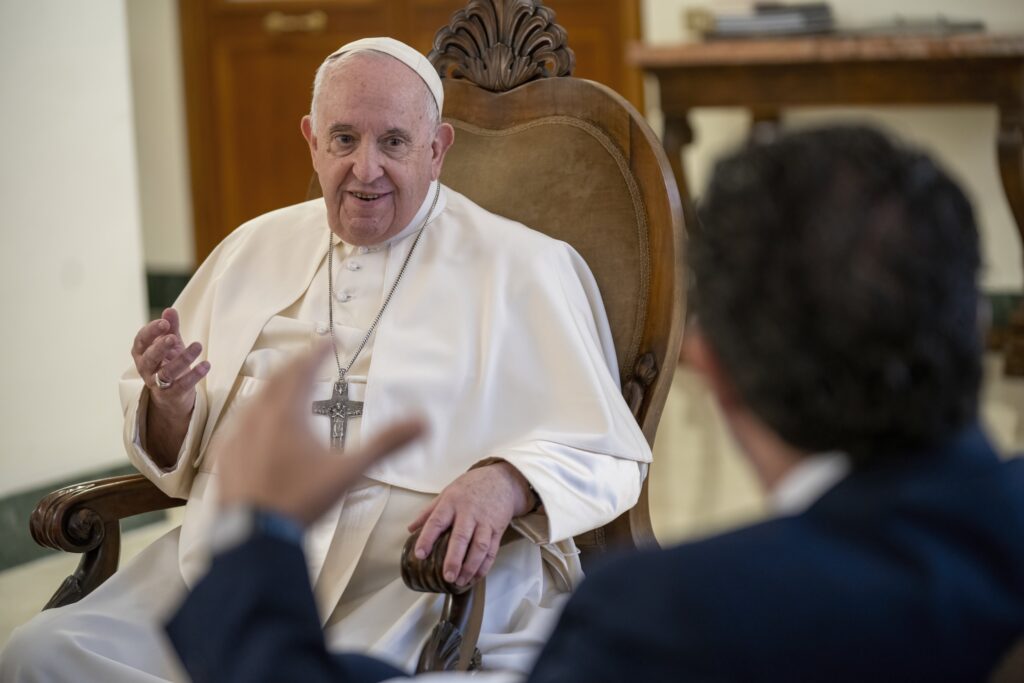
VATICAN CITY (CNS) — The work of journalists is to listen and convey the truth of what was really said, Pope Francis told a Catholic weekly magazine.
“I would also like to take this opportunity to thank, through you, all journalists for their work. It is a noble profession: to convey the truth,” he said in an interview with Tertio, a Belgium-based Dutch-language publication.
The lengthy interview, which took place Dec. 19, 2022, in Spanish, was published online in Dutch at tertio.be Feb. 28; the Vatican newspaper published an Italian translation of the interview the same day.
The pope said the tasks of a journalist are “listening, translating and dissemination” with listening being the key first step.
“There are journalists who are brilliant because they say clearly, ‘I listened, he said this, even though I think the opposite,'” he said. “You should not say, ‘He said this,'” when that was not what was said.
“Listen, report the message and then criticize. Journalists are doing a tremendous job,” he said.
The reporter reminded the pope about an open letter that was signed by dozens of journalists and sent to him last year asking that St. Titus Brandsma, a Dutch Carmelite priest, journalist and martyr, be made a patron saint of journalists.
Canonized by Pope Francis in May 2022, the saint was “someone who shared in the deeper mission that should drive journalism in modern times: a search for truth and veracity, the promotion of peace and dialogue between people and populations,” the open letter said.
“Does our request have any chance of being considered?” the reporter asked the pope.
The pope said, “I completely agree with this proposal,” adding that there was another saint who also would be appropriate, referring to St. Maximilian Kolbe, a Franciscan priest, journalist and martyr, who had been arrested on charges of aiding Jewish refugees and the Polish resistance.
Pope Francis said he was going to contact the Dicastery for the Causes of Saints “to see what is possible. It would certainly be my pleasure.”
Asked about the Second Vatican Council and why its implementation is “so close to your heart,” the pope said, “Historians say it takes a century for the decisions of a council to take full effect and be implemented. So we still have 40 years to go. I am so committed to the council because that event was actually a visit of God to his church.”
The council “is not just a question of renewal, but also a challenge to make the church more and more alive. The council does not renew, it rejuvenates the church” without losing her “age-old wisdom,” he said.
“The church is a mother who is always moving forward. The council opened the door to greater maturity, more in tune with the signs of the times,” he said.
“The structure of the church, the traditional — if correctly understood — is always modern. This is because tradition continues to develop and grow,” he said. “From the root we always continue to grow. The council took such a step forward, without cutting off the root, because that is not possible if you want to produce fruit.”
Asked about his hope for and aim with the current synodal process, the pope recalled how St. Paul VI noted the church in the West “had almost lost its synodal dimension, while the Eastern Catholic churches had been able to preserve it.”
The saint established the General Secretariat of the Synod of Bishops in order to promote synodality in the church again, he said, and “over the past 60 years, this has become more and more pervasive.”
Some questions are finding more clarity, he said, for example, whether only bishops had the right to vote. “Sometimes it was not clear whether women could vote. At the latest Synod on the Amazon in 2019, spirits were maturing in that direction.”
The current synodal process and the two synods on synodality, he said, “will help us clarify the meaning and this methodology of decision-making in the church.”
The synod is not “a parliament,” but is a gathering of believers who take time for prayer so the Holy Spirit can help, he said.
It is a meeting of people of faith, “led by the Holy Spirit, but equally tempted and seduced by the evil spirit,” he said.