“It was now about noon and darkness came over the whole land until three in the afternoon because of an eclipse of the sun”
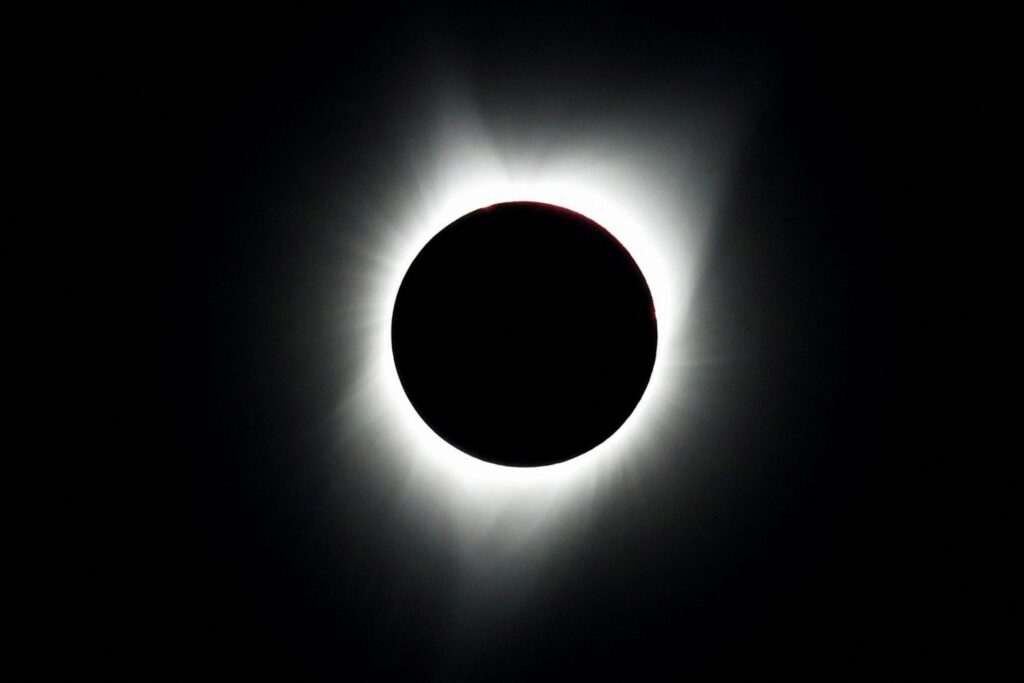
A total solar eclipse is photographed from atop Carroll Rim Trail at Painted Hills, a section of the John Day Fossil Beds National Monument, near Mitchell, Oregon, on Aug.ust 21, 2017. A total solar eclipse, dubbed "The Great North American Eclipse," takes place on April 8, 2024, and the next such eclipse visible in the U.S. will happen in August 2044. (OSV News photo/Adrees Latif, Reuters)
Was there a total solar eclipse when Jesus died?
In Luke 23:44-45 of the New American Bible Revised Edition — the Bible translation heard at U.S. Catholic Masses — the verses explicitly refer to a solar eclipse preceding Jesus’ death: “It was now about noon and darkness came over the whole land until three in the afternoon because of an eclipse of the sun.”
Both the New Revised Standard Version Catholic Edition and the New Jerusalem Bible — EWTN founder Mother Angelica’s favorite teaching Bible — simply state “the sun’s light failed.”
The Contemporary English Version — a New Testament translation approved by the U.S. Conference of Catholic Bishops — declares, “The sun stopped shining.”
The Douay-Rheims version of the New Testament — published in 1582 and used for centuries by English-speaking Catholics — asserts “the sun was darkened.”
Scientists say a solar eclipse was impossible — because the maximum duration of a solar eclipse is seven minutes and 32 seconds, not three hours.
Of course, in Isaiah 45:12 God declares, “it was my hands that stretched out the heavens, and I commanded all their host.”
Some scientists and scholars also propose a different phenomenon.
According to NASA, “Christian texts mention that the Moon turned to blood after Jesus’s crucifixion — potentially referring to a lunar eclipse, during which the Moon takes on a reddish hue. Using this textual source, scholars narrowed down a possible date of crucifixion to Friday, April 3, A.D. 33 because a lunar eclipse occurred that day.”
The academics in question are Colin Humphreys of the University of Cambridge and W.G. Waddington of the University of Oxford, who in 1990 stated in Nature Magazine, “We have suggested that the most probable date for the crucifixion was on 3 April in A.D. 33, in part basing our claim on a lunar eclipse visible from Jerusalem on that evening.”
Tras el Ángelus de ayer, los fieles podrán verlo de nuevo el miércoles por la mañana durante la audiencia general.
By:
Vatican News
| 10/19/2026
Cardinal Timothy Dolan (center right) celebrates Mass for the 125th anniversary of St. Philip Neri in the Bronx, joined by Auxiliary Bishop Joseph Espaillat (right) and Father Daniel O'Reilly (left) current pastor of St. Philip Neri. Photo: Steven Schwankert/The Good Newsroom