



America250: Gov. Al Smith and Fr. Francis Duffy
By: Steven Schwankert
A governor and a chaplain courageously carried their faith into the public square
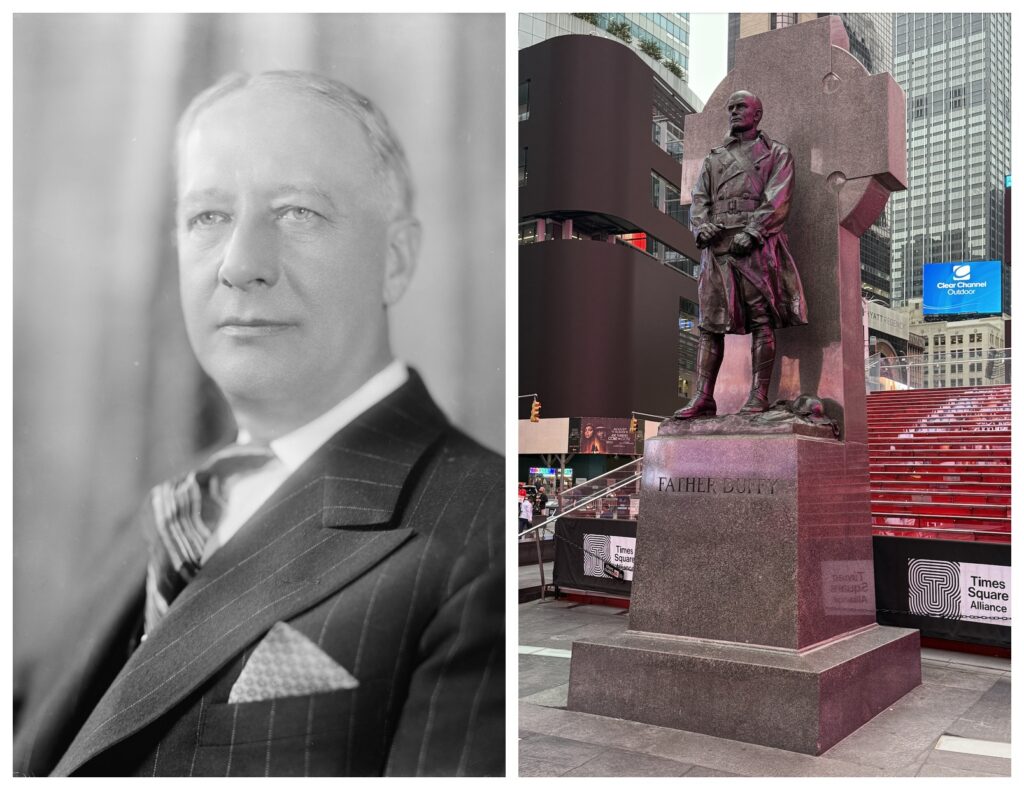
In the early decades of the 20th century, as the Catholic Church in America came of age, two New Yorkers showed what it meant to carry the faith into public life.
One rose from the tenements of the Lower East Side to become the first Catholic nominated for president by a major American political party. The other ministered to dying soldiers on the battlefields of France and became so beloved by his city that a corner of Times Square bears his name. Their paths would cross at a defining moment in American Catholic history. Together, Gov. Alfred E. Smith and Father Francis P. Duffy represent the fullest expression of what Catholic service to the common good can look like.
From the tenements to the governor’s mansion
The late New York Post and New York Daily News columnist Pete Hamill once called Al Smith, “a terminal New Yorker (04:20),” someone who spoke with a distinctive accent that has now all but disappeared from the five boroughs.
Alfred Emanuel Smith was born on Dec. 30, 1873, in a tenement on Oliver Street on the Lower East Side of Manhattan, the son of Irish and German immigrant parents. Raised in the shadow of St. James Church and educated by the Christian Brothers, he was forced to leave school at 14 after his father’s death to help support his family.
He never earned a college degree. What he earned instead was an education in the lives of ordinary New Yorkers that would shape everything he did in public life.
Smith rose through the ranks of Democratic politics, a reliable path of advancement for immigrant Catholics in New York. But he was never simply a politician.
As a member of the New York State Assembly beginning in 1903, he emerged as one of the most effective reformers of his generation. After the Triangle Shirtwaist Factory fire of 1911, which killed 146 garment workers, many of them young immigrant women, Smith worked alongside Frances Perkins to pass factory safety legislation that became a national model.
Elected governor of New York four times, serving from 1919 to 1920 and again from 1923 to 1928, Smith championed the poor, organized labor, and a vision of government as an instrument of human dignity. He reorganized the state government, built public housing, expanded parks and hospitals, and pushed through reforms rooted in. However, he would not have framed it this way; in the Catholic social tradition he had absorbed since childhood.
Smith was also an unapologetic “wet,” an opponent of Prohibition, who saw the anti-alcohol legislation as being aimed and implemented in an anti-Catholic and anti-immigrant manner.
In 1928, the Democratic Party nominated Smith for president, the first Catholic to receive a major party’s presidential nomination. The year before, a Protestant lawyer named Charles C. Marshall had published a letter in the Atlantic Monthly questioning whether a Catholic could be a loyal president or whether his allegiance to the Pope would come first.
Smith was given a chance to reply, and the man he turned to for help drafting that reply was a priest named Father Francis P. Duffy. The resulting article was a landmark defense of American Catholic patriotism, arguing for the separation of church and state in terms that anticipated the Second Vatican Council’s Declaration on Religious Freedom by nearly four decades. It was not enough. Smith lost to Herbert Hoover in a landslide and never ran for office again. He died on Oct. 4, 1944.
Smith’s legacy is continued by the Alfred E. Smith Memorial Foundation, created by Cardinal Francis J. Spellman not long after Smith’s death. The organization continues to serve the poor throughout the New York area, and its key fundraiser, the annual Alfred E. Smith Memorial Dinner, has become an important stop for the top political figures and civic leaders of our time.
Chaplain of the Fighting 69th
That priest who wrote Al Smith’s defense of his faith, Francis Patrick Duffy, was born in Cobourg, Ontario, Canada, on May 2, 1871. He was ordained a priest of the Archdiocese of New York in 1896. He taught philosophy at St. Joseph’s Seminary in Yonkers and edited New York Review, one of the most progressive Catholic journals in the country, and seemed destined for a life of the mind.
Then came the Great War.
When the United States entered World War I, Duffy was serving as chaplain to the 69th Infantry Regiment, the storied Irish-American unit from New York known as the Fighting 69th. He deployed with them to France in 1917 and remained at their side through some of the war’s most brutal fighting, including the Oise-Aisne and Meuse-Argonne offensives.
He administered last rites under fire, carried the wounded, and buried the dead. He became the U.S. Army’s most highly decorated chaplain.
A Catholic vision of service
After the war, Duffy returned to New York as pastor of Holy Cross Church on West 42nd Street, steps from the theater district. He was beloved across the city, a confessor to Broadway actors, stagehands, and ordinary New Yorkers alike.
When he died on June 26, 1932, his requiem Mass at St. Patrick’s Cathedral drew an estimated 25,000 mourners. His coffin was borne on a military caisson, his riderless horse following behind.
Five years later, on May 2, 1937, Mayor Fiorello LaGuardia dedicated a bronze statue of Fr. Duffy by sculptor Charles Keck in the northern triangle of Times Square. In this representation, Fr. Duffy stands in a trench coat, looking like he is about to brave an enemy charge. His stare looks out upon the flashing advertisements and millions of tourists that pass by him each year.
The plaza has been known as Father Duffy Square ever since. The statue shows him in front of a Celtic cross, in uniform, facing the street, as if making his rounds. Almost 90 years later, this memorial to a Catholic priest’s life of service still stands near the center of the Crossroads of the World, one of the planet’s most visited spots.
Smith and Duffy were products of the same Catholic New York world, shaped by parishes and immigrant neighborhoods, and bound by the conviction that faith demanded engagement with the world rather than retreat from it.
In the year of America’s 250th anniversary, their witness remains as timely as it was urgent.