

Read an Excerpt from Cardinal Timothy Dolan's Latest Book, 'He Is Not Here'
By: Cardinal Timothy M. Dolan
At once a pilgrimage and an invitation, Cardinal Dolan’s latest book calls readers not only to remember where their faith began, but to rediscover it as a source of encounter, resilience, and hope
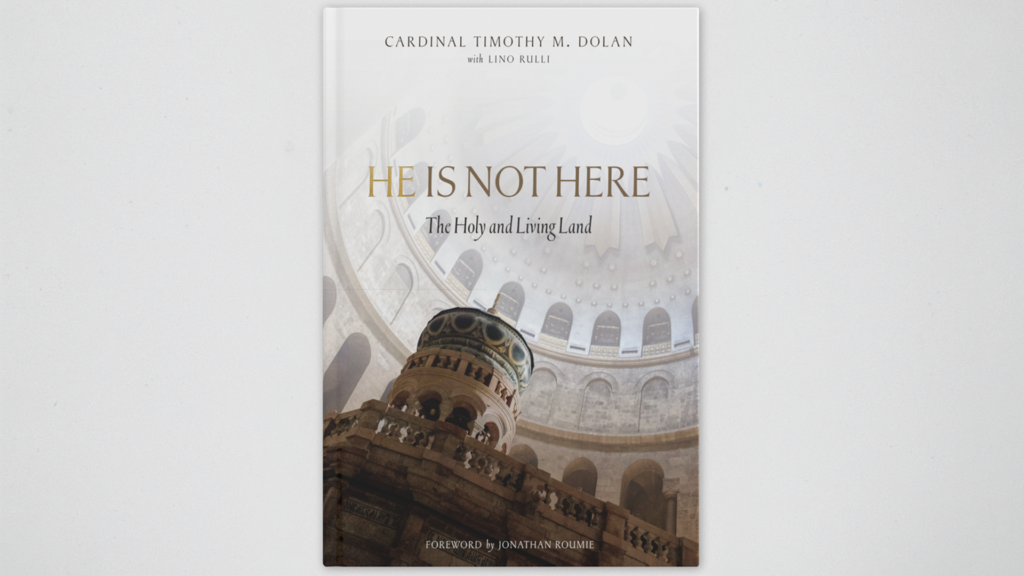
Published on Monday, Nov. 16, 2026, Cardinal Timothy M. Dolan’s latest book, “He Is Not Here: The Holy and Living Land,” with Lino Rulli, is at once a pilgrimage and an invitation. Cardinal Dolan calls readers not only to remember where their faith began, but to rediscover it as a source of encounter, resilience, and hope.
The Good Newsroom is pleased to present two excerpts from “He Is Not Here” on Monday, Nov. 16, and Tuesday, Nov. 17. The book is available now from Word on Fire and at fine bookstores everywhere.
It was April 14, 2024, at 1:50 a.m.
I was asleep in Jerusalem when the air sirens went off.
That sentence alone tells you something about the Holy Land, doesn’t it? For many people, those words fit perfectly together: Jerusalem and sirens. Conflict. Danger. Headlines. History that never seems to stop repeating itself. But let me tell you what it felt like.
I was in Jerusalem with a small contingent of folks: my coauthor, Lino Rulli; my longtime communications director, Joe Zwilling; and my priest secretary, Father Ryan Muldoon. We were guests of the Catholic Near East Welfare Association, CNEWA, a remarkable organization that for generations has quietly and faithfully served the people of the Holy Land and the broader Middle East. We had spent our days visiting holy sites—places soaked in Scripture, prayer, and centuries of devotion—and meeting the people CNEWA serves: families, clergy, religious sisters, refugees, mothers, and children.
That night, we were staying at the Notre Dame Center, just outside the Old City walls. Before we went to bed, we were told where the bomb shelter was. No drama. No panic. Just information. That too tells you something about life in this land.
When the air raid sirens sounded, we woke up immediately. Iranian missiles were aimed at Israel. And so, like so many before us and so many around us, we did what people do there: We went underground and took shelter. For about half an hour, we waited.
I wish I could tell you that I was fearless, or that I was serenely quoting psalms. The truth is more ordinary and more human. I felt nervous but safe, alert yet secure. I felt oddly calm. There we were, sitting together beneath one of the most contested pieces of land on earth, waiting for an all clear. And then it came. We returned to our rooms. We went back to sleep.
By morning, we were on a bus heading to Bethlehem for Sunday Mass in the Palestinian territories. People were going to church. Shopkeepers were opening their doors. Restaurants were preparing for lunch. It was as if the attack had never happened.
That’s why I begin this book with that story. When people think of the Holy Land, they think almost exclusively of war and conflict. A fight over land and borders that seems endless. A place defined by what divides rather than what unites. A land frozen in hostility.
But that’s not the whole story. It’s not even the best story. There’s so much more to this place.
In America, we have a saying: “Never forget where you came from.” It’s good advice for individuals, for families, for communities. It’s even better advice for believers. We Catholics—indeed, all Christians—must never forget where we came from. We came from here. From this land. From these hills and valleys. From these streets and stones. From these sacred acres of the Lord’s vineyard.
This is where Jesus walked. Where He preached and healed. Where He was born, where He died, where He rose. This is where His holy Mother lived and loved and suffered. This is where the Church was born, trembling and hopeful, in the shadow of the resurrection.
And whenever I’m in the Holy Land, my thoughts turn again and again to mothers.