



America250: Archbishop Fulton Sheen and Cardinal John O’Connor
By: The Good Newsroom
Two archbishops who made New York’s faith impossible to ignore, and what they still say about being Catholic and American
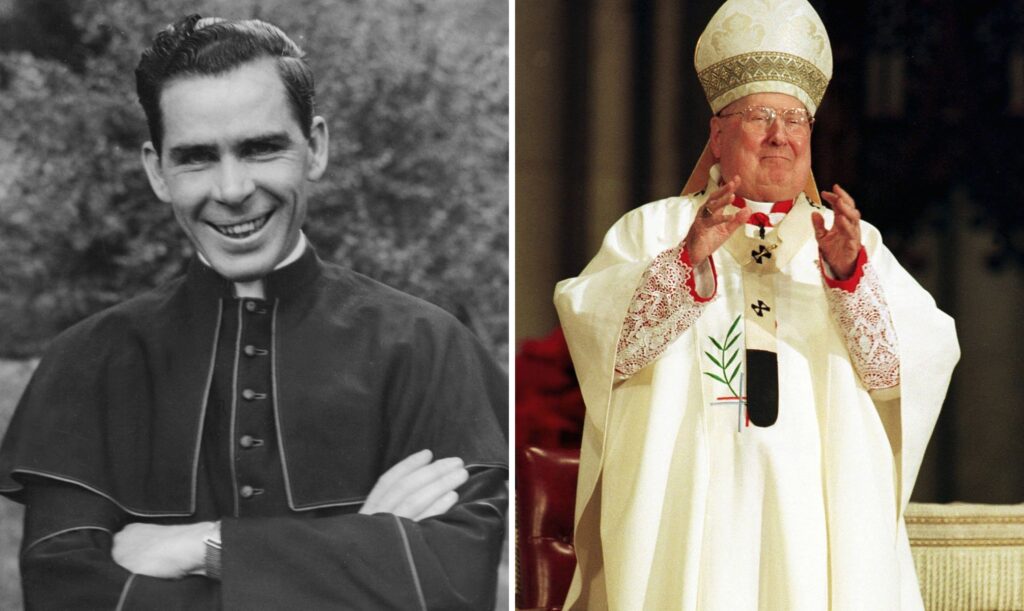
Archbishop Fulton Sheen never served in New York’s chancery, and John Cardinal O’Connor never hosted a weekly television program. Yet the two men bracket the 20thcentury Church in America the way bookends frame a bookshelf.
Archbishop Sheen taught millions how to talk about God on the public airwaves. Cardinal O’Connor, decades later, taught a city how a bishop could hold his ground in public life. Together, they demonstrate that being Catholic and being American were never competing identities in New York.
A voice made for the whole country
Archbishop Fulton J. Sheen was born in El Paso, Illinois, in 1895 and ordained a priest of the Diocese of Peoria in 1919. But it was his time in the Archdiocese of New York that made him a national figure. He first reached a national audience in the 1930s and ’40s as host of “The Catholic Hour” on NBC Radio, drawing millions of regular listeners as a young priest. After he was appointed an auxiliary bishop of the Archdiocese of New York in 1951, then-Bishop Sheen transformed that following into his “Life Is WorthLiving” broadcast from a studio built for network television, drawing as many as 30 million viewers per week at its height. He appeared alone onscreen, in a cassock, at a blackboard, discussing philosophy, current events, and the threat of communism without a script. . His command of the material came from his knowledge, his faith, and from hours of preparation rather than any teleprompter. He won an Emmy Award in 1953 for outstanding television personality and accepted it, he said, on behalf of his four writers, “Matthew, Mark, Luke and John.”
Archbishop Sheen radical was a pioneer in his astute use of television as an evangelization medium. He trusted his audience, Catholic and otherwise, to follow a real argument rather than a slogan. He went on to serve as national director of the Society for the Propagation of the Faith and was later appointed as Bishop of Rochester. He retired and returned to New York for his final years. He died in 1979, kneeling in prayer before the Blessed Sacrament, the posture that had defined his 60-year priesthood.
Archbishop Sheen’s cause for canonization opened in 2002, and after a long and public delay, the Vatican confirmed his beatification will take place on Sept. 24 in St. Louis, Missouri, with Cardinal Luis Antonio Tagle presiding on behalf of Pope Leo XIV. Pope Leo has said he watched Archbishop Sheen’s television broadcasts as a child, and he was elected pope, fittingly, on his birthday, May 8. Archbishop Sheen will become “Blessed” this fall, one formal step away from the sainthood thousands of Catholics who never met him already believe he has earned.
The chaplain who became a defender of life
John Joseph O’Connor arrived in New York very differently, in a Navy uniform rather than in front of a camera. He served 27 years as a Navy chaplain, rising to rear admiral and chief of chaplains, ministering to Marines and sailors far from any parish before he ever stood at the altar of St. Patrick’s Cathedral. He carried that discipline, and that comfort with duty, into every year of his time as archbishop of New York, a position he held from 1984 until his death in 2000. He led directly, without much patience for ambiguity, and was always willing to say plainly what the Church believed, regardless of public opinion.
That willingness made Cardinal O’Connor one of the most consequential public Catholics New York produced in the 20th century. Governors and mayors sparred with him in the newspapers, and New Yorkers who never set foot in a Catholic church knew his name and his opinions.
Yet the achievement Cardinal O’Connor himself considered most important was quieter than any headline. In 1989, his published an essay in Catholic New York titled “Help Wanted: Sisters of Life,” calling for a new order of religious sisters that would make the value of life their charism. Two years later, on June 1, 1991, eight women answered that call and became the first Sisters of Life. Since then, the Sisters have since grown to more than 100 members, with a motherhouse in Suffern and communities now serving the Archdioceses of New York, Philadelphia, Denver, Phoenix, Washington and Toronto, and the Dioceses of Albany and Bridgeport, a living and thriving institution.
His legacy is still visible in the city he led. East 50th Street on the south side St. Patrick’s Cathedral is known as John Cardinal O’Connor Way, and each year sisters, clergy and the faithful gather there to mark the anniversary of his passing, a quarter century on and still counting. Priests he ordained and mentored still credit him with the advice that carried them through discouraging seasons of ministry. Bishop of Rochester John Bonnici, who served as the head of the Archdiocese of New York’s Office of Family Life under Cardinal O’Connor, recalled years spent on difficult pro-life work, remembered his former boss telling him plainly, “Johnny, relax. Calm down. Take it easy,” a reminder that the work of building a culture of life was never meant to rest on one person’s shoulders alone.
Celebrating the Catholic history of America250 in the Archdiocese of New York
Archbishop Sheen showed that a Catholic voice could command the whole country’s attention without apology. Cardinal O’Connor showed that a Catholic leader could hold firm convictions in the nation’s largest, loudest city and still be respected, even by people who disagreed with him. Neither man asked permission to be fully Catholic and fully American at once, and neither found the two identities in tension.
That inheritance did not begin with either of them. Long before there was a United States, St. Isaac Jogues bled for this faith on New York soil, killed near present-day Auriesville in 1646. Within a generation, a Mohawk woman named Kateri Tekakwitha professed that same faith, choosing baptism at 19 despite her own village’s ridicule and living out a brief, radiant holiness that made her, in 2012, the first Native American saint. A missionary’s martyrdom and a convert’s quiet perseverance, centuries apart and impossible to separate, planted the seeds of faith that have grown into an archdiocese.
That is the through line this summer’s celebrations recall: an Irish immigrant bishop who built a cathedral out of defiance, a Haitian man, born enslaved, who donated his fortune for strangers, a governor who lost an election to bigotry but never lost his faith, a chaplain who followed soldiers into war zones and is honored today in Times Square. As America marks 250 years, the Archdiocese of New York can look and see the contributions of faithful Catholics throughout its development.